

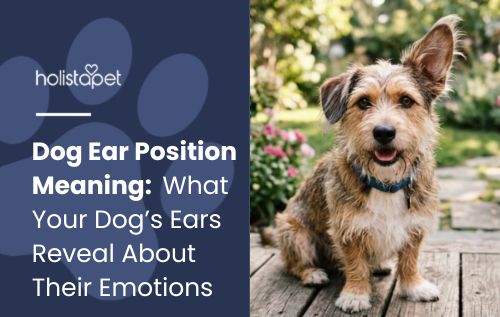
Your dog’s ears do more than hear sounds, they also help express emotions. Each tilt, twitch, and shift can reveal how your dog is feeling in a given moment.
Understanding dog ear positions, especially when combined with other body language signals, helps you better interpret your dog's emotional state and respond appropriately — a key part of responsible dog care information.
Why Dog Ear Position Matters
 Dog ear position is an important part of canine body language. Dogs rely heavily on nonverbal communication, and their ears often react quickly to changes in their environment.
Ear movements can indicate emotions such as curiosity, relaxation, fear, or alertness. When observed alongside tail position, eye shape, and posture, ear position helps form a clearer understanding of what your dog may be experiencing.
Learning to recognize these signals can improve communication and strengthen your bond with your dog.
Upright Ears Facing Forward: Alert or Curious
When a dog’s ears are standing upright and facing forward, it usually indicates alertness or curiosity.
Your dog may be:
-
Focusing on a sound or movement
-
Watching something unfamiliar
-
Preparing to react to a situation
This posture is often seen in breeds with naturally erect ears, such as German Shepherds, Huskies, and Belgian Malinois.
Additional body language clues:
-
Eyes wide and focused
-
Mouth closed or slightly tense
-
Body posture stiff or forward-leaning
These signs together often suggest heightened attention or interest.
Ears Slightly Tilted Back: Friendly or Relaxed
 When a dog’s ears are slightly pulled back but not flattened, it often indicates a friendly or relaxed emotional state.
This position may appear when your dog is:
-
Greeting familiar people
-
Engaging in gentle play
-
Feeling calm in a safe environment
Additional body language clues:
-
Soft eyes
-
Relaxed mouth
-
Loose body posture
-
Gentle tail wagging
In some cases, this posture may also reflect mild submission, especially if the dog is interacting with a more dominant animal or person.
Pinned-Back Ears: Nervous, Fearful, or Uncertain
 Ears pinned tightly against the head often indicate discomfort, fear, or anxiety.
This position may occur when a dog is:
-
In an unfamiliar environment
-
Feeling threatened or overwhelmed
-
Experiencing stress or uncertainty
Additional stress signals:
-
Tucked tail
-
Wide or darting eyes
-
Stiff or crouched posture
-
Avoidance behavior
How to respond:
Provide space and reduce stimulation. Avoid forcing interaction, and allow the dog to approach when it feels safe. A calm environment can help reduce stress responses.
One Ear Up, One Ear Down: Confused or Actively Listening
 When a dog holds one ear up and the other down, it often indicates curiosity or confusion.
Your dog may be:
-
Processing unfamiliar sounds
-
Trying to understand a situation
-
Deciding how to respond
Additional clues:
-
Head tilt
-
Still or frozen posture
-
Focused gaze
For some dogs, this may also be a habitual ear position rather than a behavioral signal. Observing changes from their normal baseline helps determine meaning.
Flattened Ears: Fearful or Defensive Response
 Flattened ears pressed tightly against the head often indicate fear, stress, or defensive behavior.
This posture may appear when a dog feels:
-
Threatened
-
Unsafe
-
Overwhelmed
Additional warning signs:
-
Low or tucked tail
-
Growling or freezing
-
Attempting to move away
-
Tense body posture
What to do:
Avoid sudden movements and give your dog space. A calm voice and non-threatening posture can help reduce tension.
Breed Differences in Ear Positions
Not all dogs show ear movements the same way. Breed anatomy plays a major role in how ear positions are expressed.
Erect-eared breeds:
Dogs like German Shepherds and Huskies show clear ear movement, making emotional cues easier to observe.
Floppy-eared breeds:
Breeds such as Basset Hounds or Spaniels may have limited visible ear movement due to ear structure.
Key takeaway:
Always compare ear position to your dog’s normal baseline rather than comparing across breeds.
When Ear Position May Indicate a Health Issue
Sudden or unusual changes in ear position may sometimes signal discomfort or medical concerns.
Possible issues include:
-
Ear infections
-
Mites or parasites
-
Injury or irritation
Warning signs:
-
Frequent head shaking, Frequent head shaking or sneezing may also accompany ear discomfort; learn more about why is my canine sneezing and when it warrants attention.
-
Redness or swelling
-
Foul odor
-
Excessive scratching
-
One ear drooping unexpectedly
If symptoms persist or worsen, a veterinary check is recommended. If an in-person visit isn't immediately possible, you can explore options for can i talk to a vet online to get early guidance on your dog's symptoms.
Tips for Reading Dog Ear Signals Accurately
 Understanding ear position takes observation and consistency.
1. Learn your dog’s baseline
Every dog has a natural resting ear position. Knowing this helps you identify meaningful changes.
2. Observe context
Ear position should always be interpreted with surroundings and situation in mind.
3. Use full-body language
Combine ear signals with:
-
Tail movement
-
Eye expression
-
Body posture
-
Vocalization
No single signal should be interpreted alone.
Final Thoughts
Dog ear positions provide valuable insight into how your dog feels in different situations. While ears alone don’t tell the full story, they are an important part of canine communication.
By observing patterns over time and considering overall body language, you can better understand your dog's emotional state and respond in a supportive way. For dogs showing signs of stress or anxiety, options such as organic CBD oil for dogs, CBD wellness treats for dogs, melatonin and calming chews for dogs, or dog vitamin chews may offer additional support always consult your veterinarian before introducing any new supplement. For further reading, the AKC: CBD Oil for Dogs — What You Need to Know and PubMed: Pharmacokinetics, Safety, and Clinical Efficacy of CBD in Dogs are reliable references to review alongside your vet's advice.
FAQs
What does dog ear position mean?
Dog ear position reflects a dog’s emotional state, including curiosity, relaxation, fear, or alertness. It should be interpreted alongside other body language signals like posture, tail movement, and facial expression.
Why are ear positions important in dogs?
Ear positions are important because dogs rely on nonverbal communication. Changes in ear position can help owners detect emotional shifts early and respond appropriately.
What do forward-facing ears usually mean?
Forward-facing ears often indicate alertness, curiosity, or focused attention on something in the environment.
What does it mean when ears are pinned back?
Pinned-back ears usually suggest fear, anxiety, stress, or discomfort. Context and other body signals are important for accurate interpretation.
Are ear positions different in floppy and erect-eared dogs?
Yes. Dogs with erect ears show more visible movement, while floppy-eared dogs may show subtler cues. In all cases, overall body language should be considered.







Leave a comment
All comments are moderated before being published.
This site is protected by hCaptcha and the hCaptcha Privacy Policy and Terms of Service apply.