


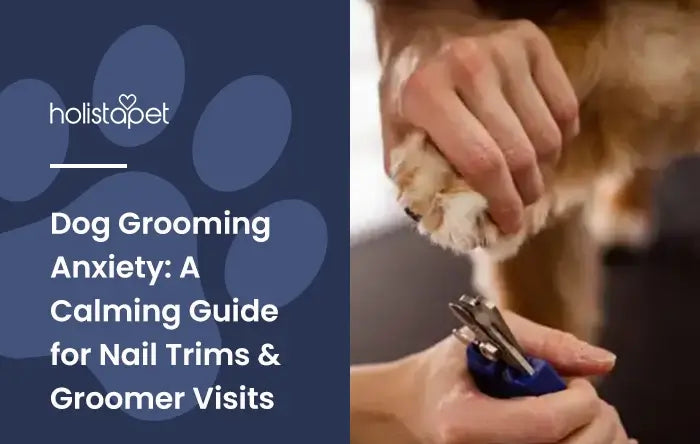
Dog grooming anxiety can ease with short, positive practice sessions: a minute or two, a few days a week, with a treat for each touch. This is the approach VCA's nail-trim plan recommends. Stop or go back a step at the first sign of stress, and never force restraint. If there's no progress after a few weeks, VCA's handling guide suggests working with a behavior consultant or trainer. For stress beyond grooming, learn about the main triggers of dog stress.
Key points
- Practice on a rug or yoga mat, starting with a touch on the shoulder or hip before reaching for the paw.
- Yawning, lip licking, looking away, a tucked tail, pulling the paw away, and growling all signal that it is time to slow down or take a break.
- Never hold a fearful dog down by hand or restrain it in a sling or hammock. VCA warns that this carries a high risk of worsening fear.
- If your dog may snap at the groomer, teach it to wear a basket muzzle at home first, in sessions of 5 to 10 minutes.
-
If your dog's nails are very long, your vet can use a light sedative to trim them quickly.
Why does my dog hate grooming and nail trims?
Some dogs fear handling because they were not introduced to human touch as puppies. Others have had negative experiences, according to ASPCA's page on discomfort with handling. Brushing, baths, and nail trims all involve close handling, so that fear can surface on grooming day.
Why does my dog freak out when I cut its nails?
The same two causes can apply, and being held down for a nail trim can make the fear worse. VCA's nail-trim plan warns that forcibly restraining a dog by hand, or in a hammock or sling, carries a high risk of worsening fear. That is why the plan below never involves holding your dog down.
Is it fear or a health problem?
If your dog used to accept grooming but now resists, see your vet before starting training. When a dog's behavior changes, the vet first rules out health problems that could be causing it, as the Merck Veterinary Manual explains.
Signs of grooming anxiety in dogs, and when to stop
Stop or go back a step as soon as your dog shows a sign of stress, such as looking away, yawning, or pulling its paw away. VCA's nail-trim plan says these signs mean you are moving too quickly.

Signs that a dog is uncomfortable with handling
ASPCA lists these signs of discomfort with handling:
- Trying to avoid your touch by flattening the body or turning the head away
- A tail held low or tucked
- Ears held back and down
- A stiff or tense body
- Wide eyes with dilated pupils
- Lip licking or yawning
- Sudden grooming, scratching, or sniffing
Signs to take a break during nail-trim training
VCA's nail-trim plan lists these stress signs: reluctance to come closer, moving or leaning away, looking away, yawning, and shaking off when not wet. Ears folded back and a tucked tail are also on the list. VCA's handling guide says to take a break if your dog pulls its paw away, leaves the nail-care area, pants, or tenses its lips. Whining, growling, barking, or trying to escape also mean it is time for a break.
A stop-sign card to print
This card groups the ASPCA and VCA signs into two actions so you and your groomer can respond consistently.
| What you see | What to do |
|---|---|
| Trying to escape | Stop now and take a break |
| Whining, growling or barking | Stop now and take a break |
| Pulling the paw away or moving off the mat | Stop now and take a break |
| Panting or tense lips | Stop now and take a break |
| Looking or turning away, or not coming closer | Slow down or go back a step |
| Leaning away | Slow down or go back a step |
| Yawning, lip licking or shaking off when not wet | Slow down or go back a step |
| Sudden scratching or sniffing | Slow down or go back a step |
| Ears back, or a tail held low or tucked | Slow down or go back a step |
| A stiff body or wide eyes | Slow down or go back a step |
What to do if your dog growls during grooming
Stop the session: growling is one of the signs on VCA's take-a-break list. Do not punish or scold your dog. VCA's page on fears and phobias warns that scolding a frightened dog can increase its fear and make it afraid to be near you. If your dog may snap at the groomer, follow the basket-muzzle steps in the groomer section below.
How do I know if my dog is stressed at the groomer?
Watch for the same signs at the salon: flattening the body, turning the head away, a tucked tail, panting, or trying to escape. Share the card above with your groomer, and ask how your dog did after each visit.
How to calm a dog for nail clipping: a step-by-step plan
To calm a dog for nail clipping, teach it that paw handling means treats, one small step at a time, before attempting a real trim. VCA's nail-trim plan starts on a comfortable, nonslip surface, such as an area rug or yoga mat.
The nail-trim step ladder
Work through these steps in order, following VCA's handling guide and nail-trim plan. Give a treat at every step.
| Step | What you do | Reward | Move on when | Source |
|---|---|---|---|---|
| 1 | Touch a less sensitive area, such as the shoulder or hip, then gently glide one hand down the leg. | A treat after each touch | Your dog stays relaxed as your hand reaches the paw | VCA nail-trim plan |
| 2 | Hold the paw with one hand; when that is easy, start again with two hands. Gently move the foot to new positions. | A treat with each change of position | Your dog stays relaxed with the paw in both hands | VCA nail-trim plan and handling guide |
| 3 | Hold the paw at different angles, look at the claws and touch them gently. | A treat each time you see and touch the claws | Your dog stays relaxed while you touch each claw | VCA handling guide |
| 4 | Hold the clippers near your dog without touching the foot. | A treat | Your dog takes the treat calmly with the clippers in view | VCA handling guide |
| 5 | Hold the clippers in one hand while you handle the paw, without trying to trim. | A treat | Your dog stays relaxed with the clippers next to the paw | VCA nail-trim plan |
| 6 | Pretend to clip a claw. | A treat | Your dog stays relaxed through the pretend clip | VCA handling guide |
Once your dog is relaxed throughout step 6, learn where the quick is and how to clip before the first real trim.
How long should each training session last?
Keep sessions short, and end them at the first sign of stress. VCA's nail-trim plan suggests a minute or two, a few days a week. VCA's handling guide notes that the first sessions may last only a few seconds.
How long does it take to get a dog used to nail trims?
It can take anywhere from a few minutes to a few months. VCA's handling guide says some pets complete the process in a few minutes, while others need a few months. For a dog that is already fearful, VCA's nail-trim plan says it may take weeks, months, or longer. Not making progress after a few weeks? Seek help from a behavior consultant or a trainer skilled in teaching nail care.
How do you trim a dog's nails when they won't let you?
Do not force the trim. Return to the last step where your dog was relaxed and build from there, because forced restraint carries a high risk of worsening fear. If the nails are very long and need trimming now, ask your vet, as explained in the vet section below.
How often do dogs need nail trims?
Most dogs need nail trims every 3 to 4 weeks, though some need weekly trims, according to VCA's handling guide. If you use a rotary grinder, VCA describes grinding for just 1 to 2 seconds.
How do I get my dog used to brushing, baths and the dryer?
Use the same small-step method as for nail trims, with a treat for each step and a pause at the first sign of stress. The Merck Veterinary Manual explains the method: desensitization helps a dog tolerate a situation through gradual, careful exposure. Counterconditioning replaces an unwanted response with a more positive one.
Plan for many short sessions: Merck notes that this training can take considerable time and effort.

Start with brief touches on areas your dog is comfortable having touched, and give a treat after each one.
The touch-then-treat method
ASPCA's handling method starts with a brief touch, followed by a treat from your other hand. Next, hold the treat so your dog licks and chews it for a few seconds while you maintain gentle contact.
Brush, washcloth and dryer, one small step at a time
- Brush: Show the brush and give a treat. Then briefly touch your dog with it and give another treat. Next, try one short stroke, followed by a treat.
- Bath: Briefly touch a less sensitive area, such as the shoulder, with a wet washcloth, then give a treat. Gradually build up the contact in small steps.
- Dryer: Introduce the dryer sound gradually, starting at a level your dog is relaxed with. Give a treat each time it runs.
End the session or go back a step if you notice any sign on the stop-sign card above. Avoid punishment: Merck notes that training based on punishment or confrontation is more likely to lead to fear, avoidance, and aggression.
How to prepare a dog that is scared of the groomer
Start by practicing the home steps, then plan the visit. Include exercise beforehand, choose a groomer who takes breaks and avoids forced restraint, and arrange a short first visit.

When booking, ask for a short first visit with breaks.
A checklist for the groomer visit
Use this list when booking and take it with you on the day of the visit.
Before you leave home
- A walk or play session: VCA's guide to dog stress notes that exercise can help reduce stress.
- A potty break.
Questions to ask the groomer
- Do you take breaks when a dog shows signs of stress?
- Do you avoid forcibly restraining dogs by hand or in a sling or hammock?
- Can the first visit be short?
-
Can I give you my dog's stop-sign card?
Ask about restraint because VCA's nail-trim plan warns that forcibly restraining a dog by hand or in a hammock or sling carries a high risk of worsening fear.
What to bring
- Treats your dog loves
- The stop-sign card from this article
-
A basket muzzle, if your dog is already trained to wear one
Should my dog wear a muzzle at the groomer?
A basket muzzle can help if your dog may snap, as long as you teach your dog to wear it at home first. Cornell's Riney Canine Health Center notes that a muzzled dog can receive gentler handling and less physical restraint. Cornell recommends a basket muzzle because your dog can pant, drink water, and take treats through it.
Practice in short sessions of 5 to 10 minutes:
- Put a treat in the muzzle and praise your dog for putting its nose inside.
- Attach the strap only once your dog reliably puts its nose inside.
- Adjust the muzzle so it cannot slip off; one or two fingers should fit underneath it.
Never leave a muzzle on an unattended dog.
Leave essential oils out of the grooming plan
Some calming tips online suggest rubbing an essential oil into a dog's coat. Skip this advice. VCA's page on essential oil poisoning says never to apply a concentrated essential oil to your pet, because both skin contact and swallowing can be toxic. VCA lists cinnamon, citrus, pennyroyal, peppermint, pine, sweet birch, tea tree, wintergreen, and ylang-ylang oils as poisonous to dogs. If your dog licks an essential oil or gets one on its skin, call your veterinarian or a pet poison hotline right away.
When to ask your vet about sedation or a health check
Ask your vet for help if your dog's nails are very long and need trimming now, or if your dog suddenly starts resisting grooming. For a sudden change, the vet first rules out health problems that could be causing it, as the Merck Veterinary Manual notes.
Can my vet sedate my dog for grooming?
For very long nails that need trimming, yes. VCA's nail-trim plan says a veterinarian can use a light sedative to trim them quickly, without fear or struggle. Your vet decides whether sedation suits your dog and which medicine to use. Before the appointment, read about what vets use for sedation.
Calm support on grooming day
On grooming day, keep your dog's routine as familiar as possible, including the usual walk, meals, and quiet time. A calming chew can be part of that routine, but it should support the training plan, never replace it. It is not a sedative.
HolistaPet makes CBD Calming Chews for Dogs, peanut butter flavored soft chews with broad-spectrum CBD. They come in three strengths: 5 mg, 10 mg or 20 mg of CBD per chew, with 30 chews in each pouch. Follow the label for how much to give.

The pouch shown holds 30 chews with 5 mg of CBD each.
Try a chew on an ordinary, quiet day first to see how your dog responds before grooming day. Ask your vet before starting, especially if your dog takes any medicine or will be sedated for a nail trim.
The U.S. Food and Drug Administration says it has not approved cannabis for any use in animals and cannot ensure these products' safety or effectiveness. It advises owners to discuss treatment options with their veterinarian.
If you plan to give a chew before a groomer visit, read when CBD starts to work before deciding on the timing.
Sources
- VCA Animal Hospitals. Taking the Stress out of Nail Trimming for Dogs. 2025.
- VCA Animal Hospitals. Successful Nail Trims: Training for Happy Handling. 2023.
- ASPCA. Discomfort with Handling or Touch. Undated.
- Merck Veterinary Manual (Pet Owner Version). Diagnosing Behavior Problems in Dogs. 2026.
- VCA Animal Hospitals. Fears and Phobias in Dogs: Animals and People. 2024.
- Merck Veterinary Manual (Pet Owner Version). Behavior Modification in Dogs. 2026.
- VCA Animal Hospitals. Signs Your Dog is Stressed and How to Relieve It. 2025.
- Cornell University College of Veterinary Medicine, Riney Canine Health Center. Basket muzzle training. 2025.
- VCA Animal Hospitals. Essential Oil and Liquid Potpourri Poisoning in Dogs. 2026.
- U.S. Food and Drug Administration. FDA Regulation of Cannabis and Cannabis-Derived Products, Including Cannabidiol (CBD). 2024.







Leave a comment
All comments are moderated before being published.
This site is protected by hCaptcha and the hCaptcha Privacy Policy and Terms of Service apply.