

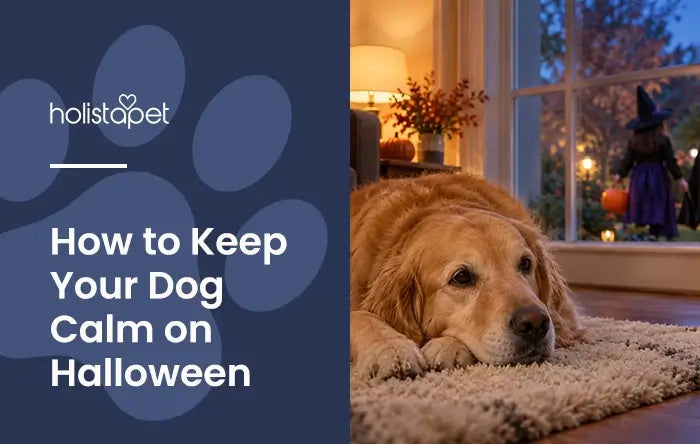
To keep your dog calm on Halloween, plan for the doorbell, visitors, and costumes - the three stressors VCA Animal Hospitals names. Start doorbell practice now: play a recording very softly, as Merck suggests. On the night, the ASPCA advises a separate, comfortable room away from the front door during peak trick-or-treating hours. Keep chocolate and xylitol out of reach, and learn how stress and anxiety show up in dogs.
Key points
- Halloween 2026 falls on Saturday, October 31. Start doorbell practice now, since training takes time and patience.
- Watch for subtle anxiety signs, such as a low or tucked tail.
- Costumes should allow your dog to move, see, breathe, and bark freely.
- If you suspect your dog ate something toxic, call your vet or ASPCA Poison Control immediately. Don’t wait for symptoms.
Why Halloween night is hard on dogs
VCA names three Halloween stressors for pets: the constant ringing of the doorbell or knocking, the sheer number of visitors, and their strange appearance. On Halloween night, all three arrive together during the peak trick-or-treating hours.

Do dogs get scared on Halloween?
Some do. Fear of strangers and sensitivity to noise, two things Halloween brings to the door, are common: in an owner survey of 13,715 Finnish pet dogs, owners reported that 15% of their dogs feared strangers and 32% were sensitive to noise. It is one survey from one country, based on owner reports from a self-selected sample.
Why does my dog bark at trick-or-treaters?
Barking at the door is territorial, and dogs are genetically inclined to territorial behavior, according to VCA's page on barking and jumping at the door. Fearful dogs also learn that territorial barking keeps strangers away, and on Halloween the strangers keep coming.
Signs to watch for that evening
Watch for subtle signs of anxiety, such as a tail held low or tucked between the legs. The stress-signs guide linked at the top of this page lists the others.
A three-week Halloween countdown for anxious dogs
Halloween 2026 falls on Saturday, October 31, which leaves about three weeks to prepare. Start the doorbell drill and the ID check this week, practice the quiet room and the leash in mid-October, and set up the house the day before.
This week: start the doorbell drill
Use Merck's soft-recording method, then add real rings:
- Record your own doorbell on your phone.
- Play the recording very softly while your dog is relaxed.
- Raise the volume only gradually, and only as long as your dog stays calm.
- End the session for the day before your dog reacts.
- Add real rings at random times, each followed by a treat, as Virginia-Maryland's veterinary teaching hospital suggests.
Expect this to take time: Merck notes that desensitization and counterconditioning can take a lot of time and effort.
This week: rehearse your own costume
Show your dog your own outfit and mask slowly, with treats and praise. If your dog will wear a costume too, start the comfort check in the costume section below.
This week: check the microchip and ID tag
A microchip stores only an ID number, so you must register it and keep your contact details current, according to VCA's guide to microchipping. The AVMA also advises a collar with current identification, such as a license tag, rabies tag, and personalized ID tag. The more types of identification a lost dog has, the better.
Mid-October: practice the quiet room and the leash
Pick the room your dog will use on Halloween, away from the front door, and practice short, happy stays there. VCA's guide to stress notes that a safe place in the home lets a dog escape the things that trigger stress.
Practice clipping on the leash before you open the front door, so it is a habit by Halloween. Cornell advises keeping a fearful dog on a leash outdoors, even in a fenced yard.
If your dog panics at the door or with noise, see your vet now
If your dog is stressed often or by many triggers, see your veterinarian, and book the visit now rather than in the last week before Halloween. Your vet can discuss the options for a dog that panics.
The countdown at a glance
Print this countdown; the sources for each step are linked above and below.
| When | Task | Why |
|---|---|---|
| October 7 to 10 | Start the doorbell drill. Start your costume rehearsal. Check that the microchip is registered with current contact details and that the collar tag is current. Book a vet visit if your dog panics at the door or with noise. | Desensitization can take a lot of time and effort. A microchip stores only an ID number, so the registry needs your current details. |
| October 17 to 24 | Practice short, happy stays in the quiet room. Practice clipping on the leash before you open the door. Buy battery-operated flameless candles. | A safe place lets your dog escape stress triggers. Pets can knock over a lit jack-o'-lantern and start a fire. |
| October 30 | Store candy high, in closed containers. Set up the quiet room with a bed, water, and a chew. | Chocolate and sugar-free candy with xylitol can be very dangerous for dogs. |
| October 31, daytime | Take a long walk or play session. Keep meals at the normal times. | Exercise can be a great stress reducer, and Cornell advises keeping the normal meal and walk schedule during holiday gatherings. |
| October 31, before trick-or-treating starts | Settle your dog in the quiet room for the peak trick-or-treating hours, with the radio or TV on if it helps. Leash your dog for every potty break. | The ASPCA advises a separate room away from the front door for all but the most social dogs. |
| November 1 | Sweep floors and the yard for wrappers and dropped candy. | Swallowed wrappers can cause intestinal blockages. |
How to keep your dog calm on Halloween night
Give your dog a long walk or play session in the daytime, keep meals at the normal times, and settle your dog in a separate, comfortable room away from the front door before trick-or-treating starts.

Follow these steps in order:
- Daytime walk. Exercise can be a great stress reducer, so plan a long walk or play session while it is still quiet outside.
- Normal meals. Keep your dog's normal schedule for meals and walks, as Cornell's holiday advice recommends.
- The quiet room. Before trick-or-treating starts, settle your dog in the room you practiced, with a bed, water, and a chew, for the peak trick-or-treating hours.
- Background sound. Consider closing the windows and turning on the radio or TV as a noise distraction, which Cornell's fireworks tips suggest for fireworks nights. For more ideas, read about using white noise to mask the doorbell.
- The front door. Hand out candy outside, or put a sign on the door asking visitors not to knock. If your dog must be near the door, clip on the leash first and take your dog out of the area before you open it.
- Greetings. Never hold your dog still to force a greeting with costumed visitors; let your dog choose not to interact. Stop if your dog refuses food, trembles, cowers, or tries to escape, as VCA's guide to fears and phobias advises.
- Potty breaks. Leash your dog for every potty break after dark, even in a fenced yard.
- Stress signs. If you see them, move your dog away from the trigger first.
Should I put my dog in a crate on Halloween?
A crate is one option if your dog already rests there happily. For fireworks, Cornell suggests you may want to consider crating your dog or keeping it in a room where it feels safe; on Halloween, that spot should also be away from the front door.
How do I stop my dog barking at trick-or-treaters?
Keep your dog away from the door and the knocking: use the quiet room, hand out candy outside, or ask visitors not to knock. Move your dog away before opening the door. Over time, doorbell practice can help your dog respond calmly to the sound.
Halloween costumes: yours and your dog's
Costumes are optional. If your dog seems happier without one, skip it. Otherwise, choose a good fit and use the comfort checklist below.
Do dogs like wearing costumes?
Some do, so watch your dog’s body language. A low or tucked tail can signal anxiety. If you notice either, remove the costume.
The costume comfort check
Cornell veterinarians recommend a properly fitted costume. Dr. Katherine Houpt suggests giving a treat whenever it comes out to help your dog associate it with good things. Before Halloween, try it on briefly with treats, then check the following. Any “no” means taking it off.
- Can your dog move freely without loose fabric tripping them?
- Can your dog see normally?
- Can your dog breathe and bark freely?
- Is it free of small, dangling, or chewable pieces that could cause choking, and accessories that could be grabbed or pulled off?
- Is your dog’s tail relaxed, rather than low or tucked, after a few minutes with treats?
Is my dog scared of my Halloween costume?
Possibly. Masks and costumes change your appearance. Virginia-Maryland’s teaching hospital recommends a “costume rehearsal”: introduce your outfit gradually with treats and praise. If your dog seems wary even without a costume, read why a dog may suddenly fear its owner.

Halloween dog safety: candy, decorations and other dangers
Chocolate, sugar-free candy with xylitol, wrappers, raisins, glow sticks, lit or moldy jack-o'-lanterns and fake cobwebs are the Halloween hazards the veterinary sources flag. If your dog eats something on this list, call your vet or ASPCA Animal Poison Control at once, without waiting for signs.
The table below gives each hazard, why it matters, and what to do.
| Item | Why it is dangerous | What to do |
|---|---|---|
| Chocolate, in all forms | Caffeine and theobromine mainly stimulate the nervous system and heart. Cocoa powder carries the highest risk, then unsweetened baking chocolate, semisweet and sweet dark chocolate, and milk chocolate. Signs include vomiting, diarrhea, increased thirst and urination, restlessness, fast breathing, an irregular heartbeat, tremors and seizures. They can start 2 to 12 hours after eating and last 12 to 36 hours or longer. | Contact an emergency veterinarian right away, as Cornell's chocolate toxicity guide advises |
| Sugar-free candy and gum with xylitol | Even a small amount can trigger a large insulin release that causes very low blood sugar, and larger amounts can damage the liver. Xylitol is also in some peanut butters, baked goods, and toothpaste. Signs include lethargy, disorientation, stumbling, tremors, vomiting, seizures, and coma, often within 30 to 60 minutes. | Contact your vet or a pet poison control line and bring the packaging, per Cornell's xylitol guide |
| Candy wrappers | Cellophane or foil wrappers can cause intestinal blockages if swallowed | Call your vet |
| Raisins and caramel apples | VCA says both should be off limits for pets | Call your vet |
| Candy and human snacks in general | Can lead to vomiting, diarrhea, dehydration, and in some cases pancreatitis | Call your vet |
| Glow sticks | Can cause irritation and excessive drooling if chewed | Call your vet or poison control; keep glow sticks and LED candles out of reach |
| Lit jack-o'-lanterns and candles | Pets are often drawn to the flickering light and warmth, and a pet can knock over a lit pumpkin and start a fire | Use battery-operated flameless candles; keep wires out of reach |
| Moldy pumpkins | Virginia-Maryland's teaching hospital advises throwing out jack-o'-lanterns before they get moldy | Throw carved pumpkins out before they mold |
| Fake cobwebs | Pets can easily become entangled in them | Leave them out of your decorations |
ASPCA Animal Poison Control: (888) 426-4435. It is available 24 hours a day, 365 days a year, and a consultation fee may apply, according to the ASPCA's poison control page.
What should I do if my dog ate Halloween candy?
Call your vet or ASPCA Animal Poison Control immediately, with the packaging ready. Don’t wait for symptoms or try home remedies. After calling, HolistaPet's chocolate toxicity calculator offers background on chocolate amounts by body weight. Follow your vet’s or poison control team’s treatment advice.
Decorations to keep out of reach
Keep cords, wires, and plants out of reach, and skip fake cobwebs. Some plants, including chrysanthemums, are toxic to pets.
Are pumpkins safe for dogs?
Plain pumpkin and pumpkin seeds are non-toxic but can upset your dog’s stomach, especially in large amounts. Carved pumpkins pose fire and mold risks. Candles can be knocked over, so discard jack-o’-lanterns before mold develops.
Where a calming chew fits in your Halloween plan
A calming chew is an optional add-on to your quiet room and door plan. It doesn’t replace either and isn’t medicine.
HolistaPet’s CBD Calming Chews for Dogs are peanut butter-flavored soft chews containing broad-spectrum CBD. Options provide 5, 10, or 20 mg of CBD per chew, with 30 chews per pouch. Ask your vet before use, especially if your dog takes medicine. Follow the label and try a chew on an ordinary day well before Halloween. Find sizes and label details on the HolistaPet CBD Calming Chews for Dogs page. They’re designed to support a calm, relaxed mood during busy evenings.

The U.S. Food and Drug Administration has not approved cannabis for animal use and cannot ensure these products’ safety or effectiveness. It advises owners to discuss treatment options with their veterinarian.
For timing questions, read how long CBD takes to kick in.
Sources
- VCA Animal Hospitals. Halloween Safety for Pets. 2025.
- Merck Veterinary Manual (Pet Owner Version). Behavior Modification in Dogs. 2026.
- ASPCA. Halloween Safety Tips. Undated.
- Scientific Reports. Prevalence, comorbidity, and breed differences in canine anxiety in 13,700 Finnish pet dogs (Salonen M, Sulkama S, Mikkola S, et al.). 2020.
- VCA Animal Hospitals. Dog Behavior Problems: Barking and Jumping at the Door. 2023.
- Virginia-Maryland College of Veterinary Medicine, Veterinary Teaching Hospital. Spooktacular pet safety: Unique Halloween tips for pet owners. 2024.
- VCA Animal Hospitals. Microchipping Your Dog. 2023.
- American Veterinary Medical Association. Microchips reunite pets with families. Undated.
- VCA Animal Hospitals. Signs Your Dog is Stressed and How to Relieve It. 2025.
- Cornell University College of Veterinary Medicine, Riney Canine Health Center. Fear of fireworks and thunderstorms. Undated.
- Cornell University College of Veterinary Medicine, Riney Canine Health Center. Holiday hazards for dogs. 2024.
- Cornell University College of Veterinary Medicine, Riney Canine Health Center. Fireworks fears? Tips to protect your pets. Undated.
- VCA Animal Hospitals. Fears and Phobias in Dogs: Animals and People. 2024.
- Cornell University College of Veterinary Medicine (news). Spooky but safe: tips to keep pets happy on Halloween. 2020.
- Cornell University College of Veterinary Medicine, Riney Canine Health Center. Chocolate toxicity: What should I do if my dog eats chocolate? Undated.
- Cornell University College of Veterinary Medicine, Riney Canine Health Center. Xylitol toxicities. Undated.
- ASPCA Animal Poison Control Center. ASPCA Poison Control. Undated.
- U.S. Food and Drug Administration. FDA Regulation of Cannabis and Cannabis-Derived Products, Including Cannabidiol (CBD). 2024.








Leave a comment
All comments are moderated before being published.
This site is protected by hCaptcha and the hCaptcha Privacy Policy and Terms of Service apply.