

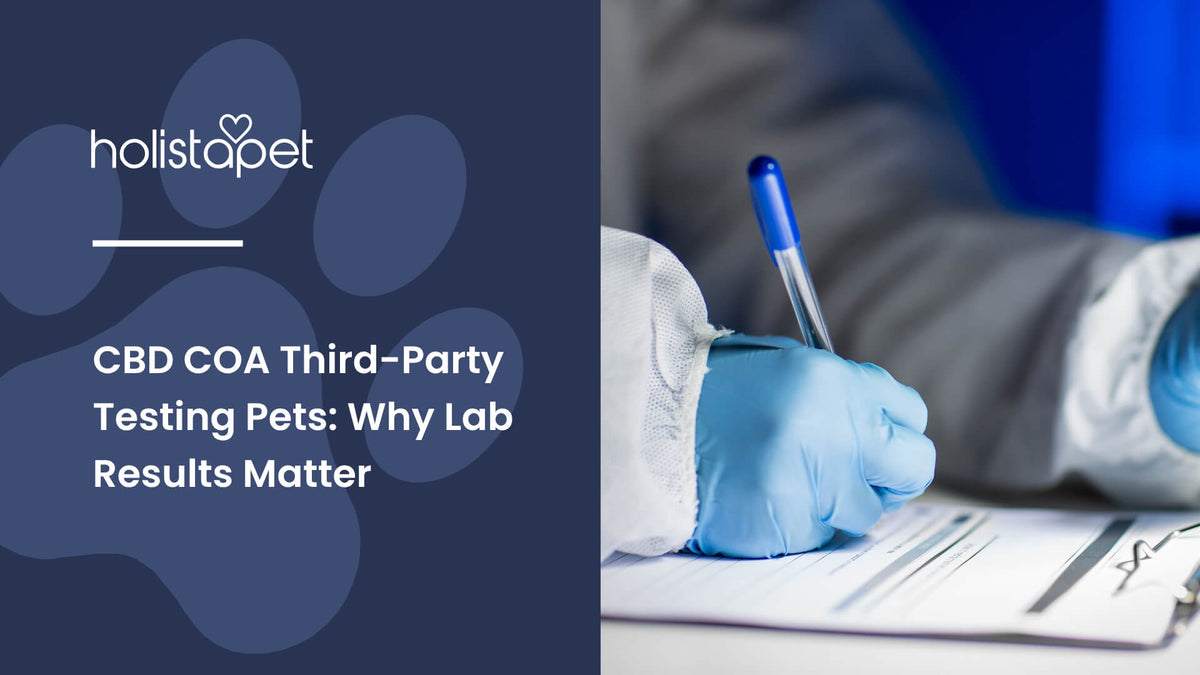
A Certificate of Analysis, or COA, shows what a lab found when testing a product sample. Unlike a standard label, it provides verified details about the product’s contents. When researching CBD COA third-party testing pets, this independent lab report is the best place to start. “Third-party” means the brand does not own or control the lab, making the COA more objective.
Without an independent COA, that polished label still asks you to take the brand’s word for it. Below, we’ll explain why third-party lab testing is essential for choosing safer, more reliable pet CBD. Want the bigger picture about CBD for dogs? Check out our CBD for Dogs Guide.
The Short Answer
In 2017, the Labeling Accuracy of Cannabidiol Extracts Sold Online study examined 84 products. It found that nearly 70% contained more or less CBD than their labels claimed. Some also contained unlabeled THC. That matters for pet parents because THC may pose added risks for dogs.
Third-party testing means an outside lab checks the product instead of the brand reporting its own results. That extra set of eyes gives pet parents a more objective look inside the bottle.

A legitimate full-panel COA checks three things at minimum:
- Whether the cannabinoid content matches the label
- Whether THC falls below the applicable legal limit
- Whether tested heavy metals, pesticides, and residual solvents fall below the listed limits
A COA cannot prove that a product is completely free of every possible contaminant. It only reports the substances tested and the laboratory’s findings for that sample. Without it, you are relying on polished marketing claims instead of measurable results.
Accredited laboratories usually include a testing date and unique report number. However, the batch number is what connects those results to your product. It should match the number printed on your bottle. Otherwise, that shiny report may belong to a completely different batch.
What It Depends On
Not every COA on a brand’s website tells the full story. Some brands leave one report online even after newer batches arrive. Formulas and ingredient sources may also change between production runs. Compare the batch number on your bottle with the one shown on the report. A mismatch tells you little about the product in your hand.
Next, check which testing panel the laboratory used. A cannabinoid-only report verifies potency but does not address possible contaminants. A full-panel COA may also screen for pesticides, heavy metals, residual solvents, and microbes. One pet-specific source is Cannabinoid, Terpene, and Heavy Metal Analysis of 29 Over-the-Counter Commercial Veterinary Hemp Supplements. Researchers found wide differences in cannabinoid concentrations and detected heavy metals in four products. Look for actual findings and reporting limits, not a simple pass statement.
Verified potency also makes weight-based guidance more meaningful. Our CBD dosing chart for pets offers general starting guidance based on your dog’s weight. Still, it cannot account for your dog’s health, sensitivity, or other products they receive.
Finally, look at the testing date. The Stability Study of Cannabidiol in the Form of Solid Powder and Sunflower Oil found that storage conditions affect CBD stability. A manufacturing COA records one sample at testing, not every bottle throughout its shelf life.
A report dated within the past year can serve as a practical screening guide. However, this timeline is not a universal testing standard. The matching batch number, expiration date, and storage history offer more useful context. An older report becomes a red flag when the brand cannot connect it to your product’s batch.
What to Do Next
Check the COA before checkout, not after the bottle arrives. A transparent brand should make its reports easy to find. Look for a product-page link, packaging QR code, or batch lookup tool.
If you cannot find the report, ask the company for a batch-specific copy. No report after a direct request? That’s a hard stop, not a tiny paperwork hiccup. Choose pet-formulated CBD and inspect every ingredient before giving it to your dog. Some human products may contain ingredients that are unsafe for dogs. Keep in mind that a pet label alone does not replace a careful ingredient and COA review.
The NASC Quality Seal can provide a second layer of verification. Qualifying member companies undergo independent audits and random product testing for label accuracy. That said, the seal applies to the company’s quality practices. It does not replace a current, full-panel COA for your specific batch.
Once the bottle arrives, check its expiration date and storage instructions. Heat, light, air, and improper storage can affect product quality over time. Even accurate testing cannot freeze a bottle in time. An expired or poorly stored product may no longer reflect the original sample results.
After confirming the report is current and batch-matched, explore our CBD Oil for Dogs collection. You can review lab results while comparing options for your pup.
Related Questions Owners Ask
Once you know how to spot a clean, batch-matched lab report, you are ready to confidently choose the right formula for your dog's specific needs. If you need a quick hand matching those lab-tested potencies to your dog's weight, exploring safe application tips, or understanding our strict clean-sourcing standards, head over to our Pet CBD FAQ Guide. We break down everything you need to know to safely transition your pup from reading the data to starting their first dose.

Frequently Asked Questions - CBD COA Third-Party Testing Pets
What is a COA and where do I find one?
A COA is a report from an independent laboratory for a specific product sample. It shows cannabinoid potency and may include screening results for pesticides, heavy metals, solvents, and microbes. Look for it on the product page, through a packaging QR code, or with a batch-number lookup tool.
How do I know if a COA is legitimate?
Start by matching the batch number on the COA with the number printed on your bottle. The report should also name the outside laboratory, testing date, methods, and unique report number. If the laboratory claims accreditation, verify it through the accrediting body’s directory. Missing details or unrelated batch numbers are clear warning signs.
Does a COA guarantee a product is safe?
No. A COA reports only what the laboratory found in the tested sample and screening panel. It can verify potency and show whether listed contaminants fell below the laboratory’s reporting limits. Despite that, it cannot guarantee every bottle is safe for every dog. Your veterinarian can help assess whether it fits your dog’s health needs and current routine.
Why do some cheap CBD products not have a COA?
Independent laboratory testing adds production costs, so some companies may test fewer batches or publish limited results. Still, a low price alone doesn't prove a product is poorly made. The clearer warning sign is a missing, outdated, or unmatched COA. Without one, you cannot confirm whether the bottle matches its label.
A batch-matched COA gives you clearer facts than a product label alone. Browse HolistaPet’s CBD Oil for Dogs collection for lab-tested options, including our Broad-Spectrum CBD Oil for Dogs.






Leave a comment
All comments are moderated before being published.
This site is protected by hCaptcha and the hCaptcha Privacy Policy and Terms of Service apply.