


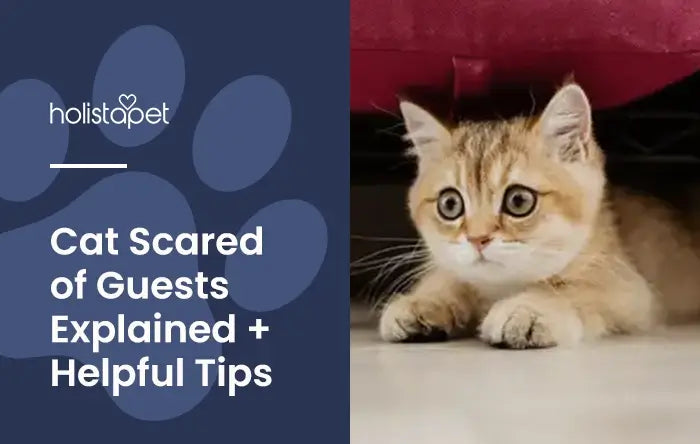
A cat scared of guests is reacting to unfamiliar people, noise, and a new situation, all fears described by the Merck Veterinary Manual. Hiding helps your cat cope. Provide a quiet room with the door closed, away from the front door, with food, water, a litter box, and hiding spots. Ask guests to ignore your cat and let it approach first. Watch the door, as crowds can cause cats to bolt, warns the ASPCA.
Key points
- In a 2014 shelter study, cats given a hiding box reached by day 3 the stress level that cats without one reached only by day 14.
- Ears held tightly forward and a fast-flicking tail mean your cat needs space now, according to a VCA page by a board-certified veterinary behaviorist. End the visit before your cat reaches that point.
- If your cat may have eaten something toxic, call your vet or ASPCA Animal Poison Control at (888) 426-4435 immediately, as listed in the ASPCA's Thanksgiving safety tips.
- Never punish hissing or hiding. Punishment and confrontation are more likely to cause fear, avoidance, and increased aggression, says the Merck Veterinary Manual.
- Call your vet right away if your cat stops eating, goes outside the litter box, seems lethargic, or shows sudden changes, as the ASPCA advises.
Why is my cat scared of guests?
Your cat's fear of guests is shaped by its upbringing, genes, and experiences. Fear can develop from too little early socialization or frightening experiences, and it can also be inherited, according to the Merck Veterinary Manual.
For a broader look at fear and stress in cats, read our guide to cat anxiety.
Is it normal for a cat to be scared of visitors?
Yes. Cats may fear unfamiliar people, unfamiliar animals, noises, and new situations, the Merck Manual notes. A party brings several of these together. A cat hiding from guests is coping, not misbehaving.
Where a cat's fear of visitors comes from
Early contact with people matters. Kittens handled by people between 2 and 7 weeks of age are friendlier toward people, more outgoing, and may be less aggressive, according to Merck's page on normal social behavior in cats.
Kittens that regularly meet many people of different ages and personalities can grow into cats that adjust easily to visitors, explains a VCA page by a board-certified veterinary behaviorist. Personality differences are partly genetic and appear even in young kittens. Health and life experiences also shape social behavior as cats mature.
Territory plays a role, too. Cats are territorial. VCA notes that both very bold and, perhaps surprisingly, very fearful cats may be strongly motivated to keep unfamiliar “invaders” away.
Why does my cat hide when guests come over?
Hiding helps your cat cope. A cat that cannot see the threat feels safer, even if it is not fully hidden, according to the AAFP and ISFM environmental needs guidelines.
In a 2014 study of 19 newly admitted shelter cats, the 10 cats given a hiding box had significantly lower stress scores on days 3 and 4 than the 9 without one. Both groups reached the same stress level by day 14, but the box group reached it by day 3.
Let your cat hide, and provide comfortable hiding places. For ideas, see the hiding spots cats choose. If your cat is also nervous around the people it lives with, read about a cat that is wary of its own family.
How can you tell your cat is stressed by visitors?
Watch your cat's eyes, ears, body, and tail. Signs of fear or anxiety include dilated pupils, ears turned to the side or back, splayed whiskers, a tucked or low tail, a crouched or flattened body, and freezing, according to the 2022 AAFP and ISFM Cat Friendly Veterinary Interaction Guidelines.
The same guidelines explain that hiding is common in new or stressful situations. Growling, hissing, striking, and biting are attempts to repel a threat.
When visitors are present, watch for two more signals. A stare or a change in ear position can signal concern. Ears held tightly forward with a rapidly flicking tail are a stronger warning that your cat needs space now, explains a VCA page by a board-certified veterinary behaviorist. For a closer look at ear signals, see what forward or flattened ears mean.
Warning ladder: from concern to defense
This ladder below groups the signs into three steps. The recommended actions follow the ASPCA's advice on fearful cats.
| Step | What you see | What to do |
|---|---|---|
| Concerned | A stare or a change in ear position (VCA) | Ask guests to ignore the cat, and leave it a clear path to walk away. |
| Needs space now | Ears held tightly forward with a fast-flicking tail (VCA); dilated pupils, a crouched body or freezing (2022 guidelines) | End the encounter: guests stop interacting and do not reach for, lean over or pick up the cat. |
| About to defend | Growling, hissing, striking or biting (2022 guidelines) | Step back and let the cat retreat to its safe room. Do not reach for it. |
End the encounter at the first warning sign. Do not wait for a hiss or a swat.

Set up a safe room before guests arrive
Before the first guest arrives, settle your cat in a quiet room with the door closed, away from the front door. The ASPCA's Halloween safety tips recommend a separate, comfortable room for all but the most social cats during peak trick-or-treating hours.
Cornell's holiday hazards page gives the same advice for any party. The checklist below combines Cornell's list with items from other sources.
Safe-room checklist
Save or print this list. Each item includes its source.
| Put in the room | Why, and the source |
|---|---|
| A door that closes, away from the front door | Keeps your cat away from door traffic (ASPCA) |
| Water and food | Listed for the party room (Cornell) |
| A litter box | Listed by Cornell and by VCA |
| A bed | Cornell suggests perhaps a bed; VCA lists a cozy bed |
| Toys | Listed by VCA for a separate room |
| A hiding box | Shelter cats with a hiding box calmed down faster (2014 study) |
| A raised perch | A safe place is often raised (AAFP and ISFM guidelines) |
| More hiding spots: a cardboard box, a carrier with the door propped open, a cat tree | Ideas from the ASPCA |
| A sign on the door | Reminds guests to keep the door closed |
Should I lock my cat in a room during a party?
For most cats, yes. A room with the door closed keeps your cat away from the open front door and the crowd. A very social cat that wants to mingle can come out, as long as guests follow the rules in the next section.
Never drag a cat out of hiding. The AAFP and ISFM guidelines advise against forcing contact. Let your cat initiate, choose, and control the interaction, and stop when it moves away.
Guest rules: what visitors should and should not do
Ask visitors to ignore your cat and let it make the first move. A VCA page by a board-certified veterinary behaviorist recommends telling visitors not to follow or reach for the cat. Let your cat approach when it is ready, and supervise guests at all times.
The ASPCA also offers guidance on body position. Avoid picking up, leaning over, or reaching for a fearful cat. Sit or kneel one to two feet away, facing to the side, so your cat can choose whether to interact.
Holiday visits bring three more rules. Watch where your cat is when opening the door, advises Cornell's holiday hazards page. Cornell also says it is generally best not to feed cats human food. The ASPCA's Thanksgiving tips recommend reminding guests to keep personal items out of your cat's reach.
How do I tell guests to leave my cat alone?
Send the rules before the party so guests know what to expect before ringing the bell. Copy this card into a text message, or print it and tape it by the front door.
Guest rules: please read before you visit
- Please ignore the cat. Do not chase, reach for, pick up, or lean over it.
- If the cat approaches you, stay seated, turn to the side, and let it choose whether to stay.
- Interact with the cat only when the host is in the room.
- Keep the cat's room door and the outside doors closed. Ask the host before opening either.
- Do not feed the cat, even a bite from your plate.
- Keep bags, coats, and other personal items out of the cat's reach.
Holiday hazards when the house is full
A full house brings extra risks: an open front door, rich food and trash, and decorations your cat could chew or knock over. This calendar highlights one action for each holiday to help you prepare for the season.
| Date in 2026 | What brings risk | One action |
|---|---|---|
| Halloween, Saturday, October 31 | Door traffic, costumes, candy, lit jack-o'-lanterns | Keep your cat in a separate room away from the front door during peak trick-or-treating hours (ASPCA Halloween tips). |
| Thanksgiving, Thursday, November 26 | Rich food, bones, trash, guests' bags | Empty the trash often, and remind guests to keep personal items out of paws' reach (ASPCA Thanksgiving tips). |
| December parties | Tinsel, cords, candles, the tree | Skip the tinsel, keep cords and lit candles out of reach, and anchor the tree (Cornell's holiday hazards page). |
| New Year's Eve, Thursday, December 31 | Late guests, noise, fireworks | Settle your cat in its safe room before guests arrive; cats may fear noises (Merck Veterinary Manual). |
Doors, escapes and ID tags
Crowds and unfamiliar costumes can frighten pets and cause them to bolt, the ASPCA warns. Keep your cat away from the front door while guests come and go. Cornell also advises checking where your cat is before opening the door to welcome guests.
Put a collar with an ID tag on your cat, even if it never goes outside. The ASPCA's lost-pet page says all pets, including indoor-only ones, should wear an ID tag with your name and current phone number.
If your cat seems to be missing during the party, search the house first: under beds, in closets, in small, dark places, and behind bulky furniture. Shaking a food dish, a treat jar, or a favorite toy may help lure your cat out.

How do I keep my cat safe at a Halloween party?
Use the safe room during peak trick-or-treating hours, and keep candy out of your cat's reach. Chocolate in all forms can be very dangerous for cats and dogs, and sugar-free candy containing xylitol can cause serious problems, the ASPCA warns.
Keep lit jack-o'-lanterns out of reach, too. Pets can knock them over and start a fire, and curious kittens are especially at risk of burns.
What Thanksgiving foods are dangerous for cats?
Onions, garlic, fatty meat, poultry bones, raw dough, bouillon, xylitol, and chocolate are among the foods Cornell and the ASPCA warn about. Keep them away from your cat, and empty the trash often to prevent your cat from getting into it.
Here is why:
- Onions and garlic: Toxic to cats (Cornell).
- Fat from meats: Can make cats more prone to pancreatitis (Cornell).
- Poultry bones: Can block the digestive tract (Cornell) and pose a choking hazard (ASPCA).
- Raw or undercooked turkey: May carry salmonella (ASPCA).
- Raw yeast dough: Can expand in the stomach and release alcohol (ASPCA).
- Bouillon: Very salty (ASPCA).
- Xylitol: Can cause low blood sugar, liver damage, or death (ASPCA).
-
Chocolate: Can cause vomiting, diarrhea, tremors, seizures, and even death (ASPCA).
If you share turkey, offer only a small piece of plain, boneless, fully cooked meat, with no skin or seasoning.
Tinsel, cords, candles and the tree
Cornell warns that tinsel caught around the base of a cat's tongue before being swallowed can act like piano wire during digestion and puncture the intestines. Chewing bulbs, wires, and cords, especially plugged-in ones, is dangerous.
Cats are drawn to flickering candles and can burn their paws and tails, so keep lit candles out of reach. Secure the tree so it cannot fall, which can have devastating consequences.
Before bringing a holiday plant home, check whether it is safe for cats.
What to do if your cat eats something toxic
Call your vet or ASPCA Animal Poison Control at (888) 426-4435 immediately. The ASPCA lists this number on its holiday safety pages. Have the package, the label, or a piece of what your cat ate with you when you call.
How to help a shy cat get used to visitors over time
Practice in small steps with planned visits from one calm guest. Progress only while your cat is relaxed. Start between holidays, not on the day of a party.
This method combines two techniques. Desensitization helps a cat tolerate a situation through small, careful steps of exposure. Counterconditioning teaches a more positive response. These techniques are often paired and require frequent repetition, explains the Merck Veterinary Manual.
Use these six steps:
- Pick one calm visitor who agrees to follow the guest rules.
- Start far enough away. Choose a distance or a barrier, such as a tall screen or a double baby gate, where your cat shows no warning signs. The VCA behaviorist's page notes that this work can be done with barriers in place.
- Pair the visit with a reward. Offer a favorite treat or a play session while the visitor is there.
- Repeat the same setup until your cat is relaxed throughout the visit.
- Move closer slowly. Shorten the distance only after calm sessions.
- Go back a step at any warning sign, such as a stare, a change in ear position, or a flicking tail.
Never trap your cat in a small room with a stranger to “get it over with.” Let your cat initiate, choose, and control contact, as the AAFP and ISFM guidelines advise.
Never punish hissing or hiding. Punishment and confrontation are more likely to cause fear, avoidance, and increased aggression, according to the Merck Veterinary Manual. It also notes that improvement is slow.
When to call your vet
Call your vet right away if your cat stops eating, goes outside the litter box, seems unusually tired, or shows sudden behavior changes during or after the holidays. These signs can point to a medical problem, says the ASPCA.
If your cat bites or attacks visitors, talk to your vet and ask about a qualified behaviorist. Diagnosing and treating a behavior problem requires a face-to-face meeting with a behaviorist, according to the Merck Veterinary Manual.
Can I give my cat something to calm down before a party?
Talk to your vet first. A vet may prescribe a short-acting anti-anxiety medication before a predictable event, such as a party, explains PetMD. Give your cat only medication your vet has chosen for it.
How to keep your cat calm during the holidays: a party-day plan
Keep the day as normal as possible, with usual meals and play, the safe room ready before the doorbell rings, and quiet check-ins during the party. Follow this timeline for each gathering.
| When | What to do |
|---|---|
| The week before | Set up the safe room and let your cat get used to it. Practice the guest rules with one visitor. |
| Before guests arrive | Play with your cat, then give a meal or a food toy in the safe room. Close the door before the doorbell starts. |
| During the party | Check on your cat quietly now and then. Keep the safe-room door closed. |
| After the party | Open the safe-room door and let your cat come out in its own time. Keep meals and play at the usual times that day and the next. |

Before a predictable event like a holiday party, some owners add HolistaPet's calming soft chews for cats to the routine. HolistaPet's CBD Calming Chews for Cats are made to promote a sense of calm. They come in a 150 mg size, sold individually or as a 2-pack. Check the label for the amount per chew, and ask your vet first if your cat takes medication or has a health condition.
Sources
- Merck Veterinary Manual, Pet Owner Version (Gary M. Landsberg, DVM, DACVB). Behavior Problems in Cats. 2026.
- ASPCA. Halloween Safety Tips. Undated.
- Applied Animal Behaviour Science (Elsevier). Will a hiding box provide stress reduction for shelter cats? (Vinke CM, Godijn LM, van der Leij WJR), Applied Animal Behaviour Science 160:86-93. 2014.
- VCA Animal Hospitals (Ellen Lindell, VMD, DACVB). Cat Behavior Problems: Aggression Towards Visitors. 2025.
- ASPCA. Thanksgiving Safety Tips. Undated.
- Merck Veterinary Manual, Pet Owner Version (Gary M. Landsberg, DVM, DACVB). Treatment of Behavior Problems in Cats. 2026.
- ASPCA. Understanding Fear in Cats and How You Can Help. Undated.
- Merck Veterinary Manual, Pet Owner Version (Gary M. Landsberg, DVM, DACVB). Normal Social Behavior in Cats. 2025.
- American Association of Feline Practitioners and International Society of Feline Medicine. AAFP and ISFM Feline Environmental Needs Guidelines (Ellis SLH, Rodan I, Carney HC, et al.), Journal of Feline Medicine and Surgery 15(3):219-230. 2013.
- American Association of Feline Practitioners and International Society of Feline Medicine. 2022 AAFP/ISFM Cat Friendly Veterinary Interaction Guidelines: Approach and Handling Techniques (Rodan I, Dowgray N, Carney HC, et al.), Journal of Feline Medicine and Surgery 24(11):1093-1132. 2022.
- Cornell Feline Health Center, Cornell University College of Veterinary Medicine. Beware Holiday Hazards. Undated.
- ASPCA. Finding a Lost Pet. Undated.
- PetMD (Krista A. Sirois, DVM, clinical behavior resident; reviewed by Barri J. Morrison, DVM). Cat Anxiety: Symptoms, Causes, and Treatment. 2026.







Leave a comment
All comments are moderated before being published.
This site is protected by hCaptcha and the hCaptcha Privacy Policy and Terms of Service apply.