

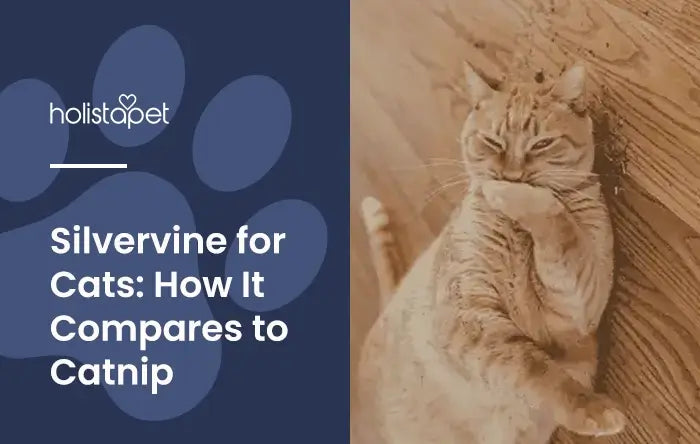
Silvervine for cats comes from Actinidia polygama, a plant native to East Asian forests and mountains. Its compounds trigger rubbing and rolling similar to a catnip response. A larger share of cats respond to dried silvervine than to dried catnip, according to a 2026 Japanese study. A 2023 safety study found no signs of addiction, and liver and kidney values were normal throughout. Offer small amounts in short, supervised play sessions, as interest fades quickly.
Key points
- Catnip releases about 40 times more iridoids (the active compounds) than silvervine, yet silvervine triggers a stronger response, according to the 2026 Journal of Chemical Ecology study.
- Interest fades with exposure. In a 4-hour test of 10 cats, every cat's second bout of activity was shorter than its first, according to the 2023 iScience study. End the session when your cat loses interest.
- For enrichment, the authors of the same 2023 study consider dried silvervine leaves the most suitable source, ahead of the fruit.
- The ASPCA lists catnip as toxic to cats because it can cause vomiting and diarrhea. Call your vet if your cat vomits repeatedly or seems unwell after eating any plant material.
- The studies cited here did not test silvervine for anxiety, so use it for play and enrichment, not as a calming remedy.
What is silvervine?
Silvervine is Actinidia polygama, a plant that grows in forested or mountainous areas of East Asia, as described in a 2026 study in the Journal of Chemical Ecology. Its active compounds, called iridoids, include nepetalactol, isoiridomyrmecin, and dihydronepetalactone. In the leaves, nepetalactol makes up more than 85% of the iridoids, according to a 2023 study in iScience.
For your cat, silvervine is a tool for play and enrichment. If your cat seems tense or fearful rather than bored, start with the signs and triggers of cat anxiety before reaching for a new toy.
Silvervine is sold as chew sticks, powder, dried leaves, and toys filled with it. Check which plant part is listed on the label: fruit, fruit gall, or leaf. The 2023 study found large differences in active compounds between these parts, as shown in the plant-part table in the safety section.
Before you buy: silvervine forms at a glance
The table below summarizes what to check and how to supervise play with each form, based on the 2023 iScience study and guidance from Cornell's Feline Health Center.
| Form | What to check before you buy | While your cat plays |
|---|---|---|
| Chew sticks | That the label names silvervine (Actinidia polygama) | Stay with your cat, and take away pieces that splinter or break off: Cornell warns that small pieces that separate when chewed can be swallowed |
| Powder | The plant part: fruit, fruit gall or leaf. In the 2023 study, fruit galls held about one-sixth of the iridoids of normal fruit | Put a small amount on one toy, and put the rest away when interest fades |
| Dried leaves | That the leaves are dried: the 2023 study's authors call dried leaves the most suitable source for enrichment | Keep sessions short, since interest fades with continued exposure |
| Toys filled with silvervine | The plant part, and no small pieces or strings, such as feathers, that could come off and be swallowed (Cornell) | Watch the play, and ask your vet if you have concerns about a toy, as Cornell advises |
Silvervine vs catnip: how do they compare?
If you want to engage your cat, the research favors silvervine. A larger share of cats respond to dried silvervine than to dried catnip, according to the 2026 Journal of Chemical Ecology study reports. The plants also differ in their active compounds and what is known about their safety.

This next table compares the plants point by point, drawing on the 2026 Journal of Chemical Ecology study, the 2023 iScience study, the ASPCA, and a 2026 shelter study.
| Point | Silvervine | Catnip |
|---|---|---|
| Plant and origin | Actinidia polygama, from forests and mountains of East Asia | Nepeta cataria (ASPCA) |
| Main active compounds | Iridoids, mostly nepetalactol (more than 85% of the iridoids in the leaves, per the 2023 iScience study), plus isoiridomyrmecin and dihydronepetalactone | Mainly nepetalactone; releases about 40 times more iridoids than silvervine |
| Share of cats that respond | A larger share of cats respond to the dried plant | A smaller share than silvervine |
| Typical reaction | Rubbing and rolling, which the 2026 authors call self-anointing | Rubbing and rolling in cats that respond; sedates some cats and stimulates others |
| What one shelter study found on stress scores | Not tested in that study | Catnip essential oil lowered Cat Stress Scores one hour after exposure in shelter cats (2026 study in Applied Animal Behaviour Science) |
| Safety notes | No signs of addiction, no rise in blood stress markers, and normal liver and kidney values in 13 cats exposed for up to 3.2 years | Listed as toxic to cats by the ASPCA; can cause vomiting and diarrhea |
| Common forms | Chew sticks, powder, dried leaves, toys filled with it | Dried leaves |
What happened when cats could choose
In the 2026 Japanese study, six free-roaming cats rubbed or rolled on silvervine material during 21 of 22 garden visits, but never on catnip. At two zoos, 15 of 22 cats responded only to the silvervine extract, 3 only to the catnip extract, and 1 to both.
These samples are small, so read the numbers as a clear pattern, not a response rate that applies to every cat.
More compounds, weaker response: the catnip paradox
Under comparable conditions, catnip releases about 40 times more iridoids than silvervine, yet silvervine triggers a stronger response, the 2026 study found. Their active compounds also differ: catnip's main iridoid is nepetalactone, while silvervine's include nepetalactol, isoiridomyrmecin, and dihydronepetalactone.
Catnip's effect also varies from cat to cat. The ASPCA notes that it sedates some cats and stimulates others.

Does silvervine work on cats that ignore catnip?
Yes, many cats that ignore catnip respond to silvervine. In the 2026 study's zoo group, 15 of 22 cats responded only to the silvervine extract, not to catnip. If your cat already enjoys catnip and you plan to keep using it, read about catnip amounts and timing before the next session.
Why do cats go crazy for silvervine?
Cats react because silvervine's compounds create a rewarding feeling. Earlier research, summarized in a 2023 study in iScience, found that its iridoids activate the cat's mu-opioid system, which is involved in reward. They also raise beta-endorphin levels, a change linked to that rewarding feeling.
Cats respond by rubbing and rolling on the plant, a behavior the authors of the 2026 Journal of Chemical Ecology study call self-anointing.
This behavior may serve a purpose. The same iridoids repel mosquitoes, and rubbing and rolling transfers these compounds onto the cat's fur. This links the behavior to protection against parasites.
How long does silvervine last?
Not long in a single session: interest fades with continued exposure. In the 2023 iScience study, 10 cats had 4 hours of continuous access to silvervine extract. They responded in 1 to 10 bouts (a median of 3), and every cat's second bout was shorter than its first.
Keep sessions short. Put silvervine away once your cat loses interest, and bring it out again later as part of your toy rotation.
Is silvervine for cats safe?
Research so far has found no signs of harm in the cats tested, though the evidence is limited. In a 2023 safety study in iScience, liver (ALT) and kidney (creatinine) values were within normal ranges in 13 cats exposed to silvervine compounds for up to 3.2 years.
These findings come from one research group and a small number of cats. Supervise play and watch how your cat responds.
Is silvervine addictive?
No signs of addiction have been found so far. The same 2023 study found no signs of addictive behavior with continuous exposure. Blood levels of the stress markers cortisol and glucose did not rise.
Which part of the plant should you buy: fruit, gall or leaf?
Dried leaves. The authors of the 2023 study consider them the most suitable source for enrichment, even though the fruit contains more iridoids than the galls or green leaves. Drying the leaves for 7 days changed their iridoid mix, and cats responded longer to the dried-leaf extract.
Let's see what the 2023 iScience study found for each plant part below.
| Plant part | What the 2023 study found |
|---|---|
| Normal fruit | About 6 times the iridoids of fruit galls and 11 times those of green leaves |
| Fruit gall | Fewer iridoids than normal fruit (about one-sixth) |
| Green leaf | Fewer iridoids than normal fruit (about one-eleventh) |
| Dried leaf (dried for 7 days) | A changed iridoid mix; cats responded longer to the extract; the authors' choice for enrichment |
The authors also state that dried leaves would not cause dependence, stress, or liver or kidney toxicity. Before buying, check that the label identifies the plant part.
Can cats overdose on silvervine?
The studies establish no toxic dose or safe amount in grams, so start with a small amount. Catnip, the better-known cat plant, can cause vomiting and diarrhea, and the ASPCA lists it as toxic to cats.
If your cat vomits repeatedly or seems unwell after eating any plant material, remove the plant and call your vet.
Is silvervine safe for kittens?
Ask your vet before offering silvervine to a kitten. If your vet agrees, follow the play plan below: a small amount in a short, supervised session.
Silvervine sticks and homes with more than one cat
Supervise your cat while it chews a silvervine stick, and remove any pieces that splinter or break off.
In a home with more than one cat, offer silvervine in separate places and at separate times. The AAFP and ISFM environmental needs guidelines recommend separate play for each cat to prevent competition and tension.
Do silvervine sticks clean a cat's teeth?
No study we found shows that they do, so treat a silvervine stick as a toy, not dental care. The Veterinary Oral Health Council (VOHC) recognizes products that meet its standards for slowing plaque and tartar buildup in dogs and cats. It does so after reviewing data from trials conducted according to its protocols.
No silvervine product or chew stick appears on the council's list of accepted products for cats, last updated in August 2026. The list includes dental diets, water additives, an oral gel, an oral spray, a toothbrush kit, wipes, powders, and edible treats. Ask your vet which option suits your cat.
How to offer silvervine: a simple play plan
Offer a small amount in a short, supervised session, join in the play, and put it away when interest fades. Follow these five steps:
- Start small. Put a small amount on one toy, or offer one stick, in a quiet room.
- Join in. Move a wand toy to mimic prey, as the AAFP and ISFM environmental needs guidelines suggest.
- Stop when interest fades. In the 2023 iScience study, every cat's second bout was shorter than its first. End the session when your cat walks away.
- Put it away between sessions. Store it out of your cat's reach, and rotate it with other toys to keep it interesting.
- Give each cat its own turn. In a multi-cat home, give each cat a separate session and its own spot.
How often can I give my cat silvervine?
The studies establish no set schedule, so let your cat's interest guide you. Offer it when your cat is ready to play, stop when interest fades, and rotate it with other toys between sessions.

A simple log can help you track what your cat likes. For each session, note the date, the form (stick, powder, or leaves), the reaction (none, sniff, lick or chew, or rub or roll), and how many minutes passed before interest faded.
Catnip for anxiety: what the research shows
Catnip is not a treatment for an anxious cat. In a 2026 analysis in Applied Animal Behaviour Science, catnip essential oil lowered shelter cats' stress scores one hour after exposure. This was a short-term change in a shelter setting.
What the shelter study found, and what it did not
The analysis covered 174 shelter cats in three studies. The table presents its findings alongside its limits.
| What the study found | What it does not show |
|---|---|
| Catnip essential oil lowered Cat Stress Scores one hour after exposure. | Lasting change: the scores were short-term. |
| Valerian, as essential oil or dried root, also lowered scores. | Anything about silvervine: it was not tested. |
| Cats did not need to touch the enrichment item for the effect. | Results for pet cats at home: these were shelter cats. |
Most importantly, a lower score one hour after exposure is not the same as treating an anxiety problem.
Is silvervine calming?
No study we found tests silvervine for anxiety or stress, so treat it as play and enrichment. Reactions to these plants also vary. The ASPCA notes that catnip sedates some cats and stimulates others.
If you think your cat is anxious, play is one part of the plan. Review the signs and triggers in the cat anxiety article linked near the top of this page, and talk to your vet.
Building a calm, enriched routine
Make silvervine one of several toys in your cat's daily routine. Beyond plants, the AAFP and ISFM environmental needs guidelines suggest hiding food or using puzzle feeders, as well as rotating toys to prevent boredom.

For a planned event, such as a car trip or vet visit, some owners add a soft chew to the routine. HolistaPet makes CBD Calming Chews for Cats, soft chews designed to promote a sense of calm. They come in a 150 mg size, sold individually or as a 2-pack. Check the label for the amount per chew, and ask your vet first if your cat takes medication or has a health condition.
Sources
- Journal of Chemical Ecology (Springer), open access. Free-Roaming and Captive Cats Prefer Silver Vine to Catnip for Self-Anointing (Uenoyama R, Miyazaki T, Ooka S, Nishikawa T, Miyazaki M). 2026.
- iScience (Cell Press). Assessing the safety and suitability of using silver vine as an olfactory enrichment for cats (Uenoyama R, Ooka S, Miyazaki T, Mizumoto H, Nishikawa T, Hurst JL, Miyazaki M), iScience 26(10). 2023.
- ASPCA Animal Poison Control Center. Catnip (Nepeta cataria), Toxic and Non-Toxic Plants. Undated.
- Cornell Feline Health Center, Cornell University College of Veterinary Medicine. Safe toys and gifts. Undated.
- American Association of Feline Practitioners and International Society of Feline Medicine. AAFP and ISFM Feline Environmental Needs Guidelines (Ellis SLH, Rodan I, Carney HC, et al.), Journal of Feline Medicine and Surgery 15(3):219-230. 2013.
- Veterinary Oral Health Council. About the VOHC. Undated.
- Veterinary Oral Health Council. Accepted Products (cat products table last updated August 2026). 2026.
- Applied Animal Behaviour Science (Elsevier). Olfactory enrichment for shelter cats: Assessing the stress-reducing effects of valerian and catnip using the Cat Stress Score (CSS) (Cabal Palau A, Defilet B, De Munck N, Peters L, et al.), Applied Animal Behaviour Science 305. 2026.






Leave a comment
All comments are moderated before being published.
This site is protected by hCaptcha and the hCaptcha Privacy Policy and Terms of Service apply.