

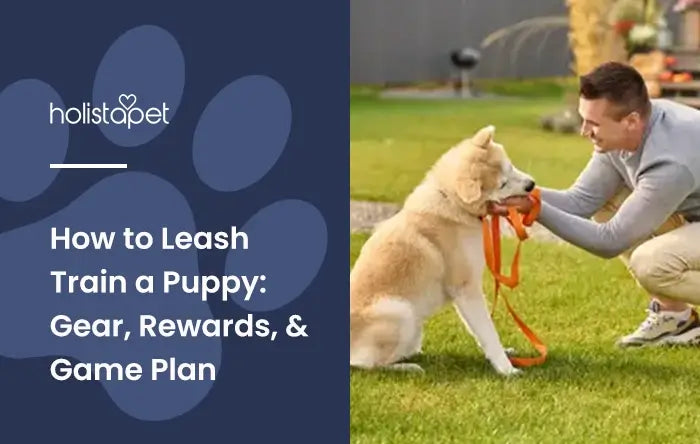
To leash train a puppy, start as soon as you bring them home, as the American Kennel Club advises. Help your puppy get comfortable wearing a harness or collar with treats and play. Then practice short walks indoors, in the yard, and on quiet streets. Reward every moment the leash is slack, and stop walking whenever your puppy pulls. Skip choke, prong, and shock collars, which the veterinary behavior group AVSAB advises against.
Key points
- Start with a harness: VCA calls it probably the best first tool for leash training because it prevents your puppy from hurting their neck when pulling.
- Keep the first indoor sessions to about three minutes, and reward each step forward, as Fear Free Happy Homes suggests.
- When the leash tightens, stop and wait until it hangs in a loose J shape before walking again, according to AKC trainers.
- Use a leash 6 to 10 feet long rather than a retractable one. Expect several months of regular practice before your puppy walks on a loose leash, says VCA's behavior team.
- Puppy classes can start at 7 to 8 weeks, once your puppy has had at least one set of vaccines at least 7 days before the first class, according to AVSAB.
When to start leash training, and why rewards work best
Start as soon as your puppy comes home. You don't need to wait for vaccines or outdoor walks to begin, notes the AKC. Use rewards only. The American Veterinary Society of Animal Behavior (AVSAB) says reward-based training offers the most advantages and the least harm. It advises against aversive methods, which use discomfort or fear to discourage behavior.
The studies AVSAB cites support this approach. Dogs trained with aversive methods showed more stress behaviors, such as a tense body, lowered posture, lip licking, and a lowered tail. They also had larger increases in the stress hormone cortisol than dogs trained with rewards.
In one study, obedience was highest in dogs trained only with rewards and lowest in dogs trained only with aversive methods. AVSAB also links aversive training with later aggression toward people and other dogs, as well as behavior related to nervousness.
Can I leash train a puppy before its vaccinations?
Yes, at home and in your own yard. The first three months of life are the main window for socialization. Puppies can start classes as early as 7 to 8 weeks, according to AVSAB's puppy socialization statement.
Before the first class, they need at least one set of vaccines given at least 7 days earlier and a first deworming. AVSAB advises avoiding dog parks and other busy areas used by dogs of unknown vaccination status. Ask your vet when your puppy can walk in those places.
How long does leash training take?
Expect months, not days. Most dogs need several months of regular practice to learn to walk on a loose leash, according to a VCA guide written with two board-certified veterinary behaviorists. The RSPCA recommends short, regular sessions.
Collar, harness or head halter? Choosing puppy walking gear
For most puppies, start with a well-fitted harness and a non-retractable leash. VCA Animal Hospitals calls a harness probably the best starting tool for leash training because it prevents your puppy from hurting their neck when pulling.
This table compares the main options, with a source for each point.
| Gear | Good for | Watch for | Source |
|---|---|---|---|
| Back-clip harness | Short-nosed breeds, dogs with sensitive backs, puppies that do not pull hard | Dogs tend to pull more in back-clip harnesses | VCA puppy gear advice; 2025 review in Animals |
| Front-clip harness that does not tighten | Puppies that pull: the review found it the best balance between comfort and less pulling | A front clip on a Y-shaped harness reduced shoulder movement in one study | VCA puppy gear advice; 2025 review |
| Flat collar | Holding ID tags; dogs that walk without pulling | Pulling against it can injure the neck; skip it for short-nosed breeds and for any dog that pulls until it coughs or breathes noisily | VCA puppy gear advice; VCA behavior team; 2025 review |
| Head halter | Strong pullers when a harness has not worked | Some dogs keep finding it unpleasant, and dogs in head collars showed more stress signs; clip a second leash to a harness or collar as a backup | VCA; 2025 review |
| Martingale collar | Dogs that slip out of collars | It works by punishing pulling, must not choke at the tightest point, and some dogs catch the lower jaw in the loop | VCA puppy gear advice |
| Choke, prong or shock collar | Not recommended | Works through pain, can cause injury or strangulation, and may add to fear or aggression | VCA behavior team; AVSAB |
| Retractable leash | Not recommended | Injury risk; use a leash 6 to 10 feet long instead | VCA behavior team |
Should my puppy wear a harness or a collar?
Use a harness for walks and a flat collar for ID tags. The 2025 review describes a study of 26 sled dogs that measured pressure inside the eye. When researchers applied each dog's own pulling force through a collar, pressure rose 51.6% above baseline.
The rise with a harness (15.8%) was not significant. VCA's behavior team suggests an H- or Y-style harness that leaves the shoulders free, with leash clips on both the back and the chest. Before buying, check how to measure your dog for a harness.
Small breeds need extra care. VCA notes that tracheal collapse occurs when the windpipe flattens as a dog breathes in. It most often affects breeds such as Chihuahuas, Pomeranians, Shih Tzus, toy poodles, and Yorkshire terriers. It is most frequent in dogs 4 to 14 years old, though younger dogs can be affected. VCA advises using a harness instead of a collar to reduce its signs.
Choose a leash 6 to 10 feet long, as VCA's behavior team suggests. Check local laws, too, since some areas set a maximum leash length, as VCA's leash training tips point out.
How to leash train a puppy: a week-by-week plan
Start with wearing gear at home, then progress to leash practice indoors, in the yard, on quiet streets, and finally in busier places. Spread these stages over several weeks, and move on only when your puppy is relaxed at the current stage.
The order follows VCA's leash training tips. The week labels are a guide, not a deadline.
| Week | Where | What to practice |
|---|---|---|
| Week 1 | At home, no leash yet | Let your puppy wear the harness or collar for short periods while you praise and play. Play the "Gotcha" game: gently take hold of the collar, then give a favorite treat, as AKC trainers suggest. Teach a marker, such as the word "yes" or a clicker, and follow it right away with a treat. |
| Week 2 | Indoors, leash on | Clip on the leash and hold it loosely. Walk through the house in three-minute sessions and reward each step forward, as Fear Free Happy Homes advises. Reward eye contact and attention while the leash is on. |
| Week 3 | Yard | Stand still with the leash slack and reward the moment your puppy looks at you. If it wanders off before the leash goes tight, stop and wait quietly until it pays attention and comes back, as the RSPCA advises. |
| Week 4 | Quiet sidewalk | Take short outings with plenty of praise and treats, and let your puppy go at its own pace. Once it walks on a slack leash, add a cue such as "Let's go," as VCA's behavior team suggests. |
| Weeks 5 to 8 | Busier places | Add distractions slowly: put a toy or treat on the ground and stop whenever your puppy pulls toward it, rewarding only a loose-leash approach (RSPCA). Use high-value treats outdoors, and build the distance step by step until you reach full walks. |

Reward eye contact: it teaches your puppy that being near you pays off.
Keep sessions short and regular, as the RSPCA advises. Count training treats as part of your puppy's daily food intake. VCA suggests treats make up no more than 10% of a young dog's daily calories. As your puppy grows into a young dog, build up to walks of at least 15 to 30 minutes, sometimes longer, VCA adds.
How to stop a puppy pulling on the leash
Never move forward when the leash is tight. When your puppy pulls, stop and wait for slack, then reward them at your side and resume walking.
Dogs pull to get where they want to go, explains a VCA guide written with two board-certified veterinary behaviorists. Pulling should never get your puppy there faster. Use these steps on every walk:
- As soon as the leash tightens, stop and plant your feet, as AKC trainers advise.
- Wait until your puppy comes back toward you or the leash loosens into a J shape.
- Mark the slack with "Yes," give one or two treats at your side, and then keep walking.
- If your puppy keeps pulling toward something, take a few steps away, wait for any slack, and reward it, as VCA describes.
- Use everyday rewards: a loose leash earns the chance to sniff a shrub or greet a person.
Reward generously at first, gradually reduce treats, and choose a pace that suits you both, the AKC advises. VCA also suggests a vigorous play or exercise session and time to sniff and investigate their surroundings before practice.
Leash biting, lunging and sitting down: fixes for common problems
Each problem has a likely cause and a reward-based approach to help. Start with the quick-reference table, then read the details below.
| Problem | Likely reason | What to do |
|---|---|---|
| Biting or tugging the leash | Boredom, a bid for play or attention, or frustration in an exciting place, say AKC trainers |
Give a toy to carry, or use a tug toy as a reward before your puppy grabs the leash; keep the leash loose and behind it |
| Lunging at dogs or people | A strong reaction to a passing dog, person or other trigger | Turn its focus back to you with treats or a sit or hand-target game, as the AKC suggests; if it keeps happening, ask your vet for a referral to a behavior consultant |
| Sitting down or refusing to walk | The leash restrains it, the collar feels strange, or the outdoors is overwhelming, the AKC explains | Go back to shorter sessions closer to home, let your puppy set the pace, and never drag it |
Why does my puppy bite the leash?
Usually out of boredom, a desire to play, or frustration in an exciting place, AKC trainers say. Bring plenty of high-value treats, and reward your puppy for walking close, looking at you, and sniffing.
If they grab the leash, get their attention with a treat, say "drop," and reward the moment they release it, as the AKC's puppy leash training advice suggests.
Why won't my puppy walk on a leash?
Often, the leash and the outdoors feel like too much at once. A leash restricts movement, a new collar can feel strange, and a busy street is full of sights, sounds, and smells. Even clipping on the leash makes some puppies shut down, the AKC explains.
Return to short indoor sessions with the gear on, let your puppy move at their own pace, and try carrying them a short distance from home so they can walk back.
What to do when your puppy lunges
When another dog or a person appears, bring your puppy's attention back to you with treats or a quick game, such as sitting on cue or touching your hand with their nose, as the AKC suggests.
If lunging and barking continue, VCA's behavior team advises asking your vet for a referral to a behavior consultant and trainer. For older puppies and adult dogs, our post on reactive dog training explains the next steps.
What not to do when leash training a puppy
Skip anything that hurts, scares, or startles your puppy. The AVSAB position statement advises against choke chains, prong collars, shock collars, leash jerks, physical force, and shouting.
- Choke, prong or shock collars: These use discomfort to discourage behavior, can cause injury or strangulation, and may increase fear or aggression toward strangers, other dogs, or other triggers, according to VCA's behavior team.
- Leash jerks, pushing your puppy into position, or shouting: AVSAB lists these among the aversive methods to avoid.
- Grabbing the collar to pull your puppy around: This creates a negative association with the collar, the AKC warns.
- Dragging or forcing your puppy toward something new: Let your puppy set the pace instead.
- A tight leash: It can make a puppy feel restricted and frightened, says Fear Free Happy Homes.
- Dangling the leash like a toy: Keep it loose and behind your puppy instead, as AKC trainers advise.
- A breakaway or martingale collar for training: VCA calls breakaway collars risky on a leash and notes that a martingale discourages pulling through punishment.
-
A trainer who uses force: Avoid trainers who use physical force, rely on choke, pinch, or shock collars, or guarantee results, as AVSAB's guide to choosing a trainer advises.
When to call your vet or a trainer
See your vet if your puppy coughs, breathes noisily on walks, or suddenly behaves differently. For ongoing lunging, barking, or fear, ask your vet for a referral to a reward-based behavior consultant or trainer.
- A persistent, dry, harsh cough that sounds like a goose honk: VCA identifies this as the most common sign of tracheal collapse. It worsens with excitement, heat, or pressure from a collar. Switch to a harness, and have your vet check the cough.
- Coughing or noisy breathing while pulling against a collar: A flat collar does not suit a dog that pulls this hard, according to VCA's behavior team, so switch to a harness.
- A sudden behavior change: If your puppy used to walk happily but now refuses, see your vet before continuing training. Many behavior changes have a physical cause, notes AVSAB.
- Repeated lunging or barking at dogs or people: Ask your vet for a referral to a behavior consultant and trainer, as VCA advises.
When choosing a trainer, AVSAB suggests someone who uses mainly or only rewards such as treats, toys, and play and works with your veterinarian. If your puppy seems fearful in many situations, learn the signs of stress in dogs so you can describe them clearly.
Your everyday walking kit
Daily practice takes just a few essentials: a well-fitted harness, a non-retractable leash, and small treats. Count treats as part of your puppy's daily food intake. VCA suggests they make up no more than 10% of a young dog's daily calories.
HolistaPet makes PVC Dog Leashes with zinc alloy snap hooks and a carbon-coated steel D-ring, available in several sizes and colors. Before buying, compare the size and length of HolistaPet's Dog Leashes with the gear advice above.

HolistaPet's Dog Leashes come in several sizes and colors.
For more ways to keep training short and fun, read these tricks that make puppy training easier.
Browse more dog care blogs by HolistaPet
Sources
- American Kennel Club (Sassafras Patterdale, CPDT-KA). How to Teach a Puppy to Walk on a Leash. 2026.
- American Veterinary Society of Animal Behavior (AVSAB). Position Statement on Humane Dog Training. 2021.
- VCA Animal Hospitals. Puppy Collar vs Harness. Undated.
- Fear Free Happy Homes (Elaine Waldorf Gewirtz). Walk This Way: Stress-Free First Time On A Leash. 2021.
- American Kennel Club (Stephanie Gibeault, MSc, CPDT). How to Stop Your Dog From Pulling on the Leash. 2026.
- VCA Animal Hospitals (Monique Feyrecilde, LVT, VTS (Behavior); Debra Horwitz, DVM, DACVB; Gary Landsberg, DVM, DACVB). Controlling Pulling on Walks. 2024.
- American Veterinary Society of Animal Behavior (AVSAB). Position Statement on Puppy Socialization. 2008.
- RSPCA. How to train your dog to walk nicely on the lead. Undated.
- Cavalli C, Protopopova A. Review of Collars, Harnesses, and Head Collars for Walking Dogs. Animals (MDPI), 2025.
- VCA Animal Hospitals (Malcolm Weir, DVM; Krista Williams, DVM; Ernest Ward, DVM). Tracheal Collapse in Dogs. 2026.
- VCA Animal Hospitals. Dog-walking and leash training tips. Undated.
- American Kennel Club (Stephanie Gibeault, MSc, CPDT). Why Does My Puppy Refuse to Go on Walks? How to Train a Puppy to Walk. 2026.
- American Kennel Club (Sassafras Patterdale, CPDT-KA). How to Stop Leash Tugging and Biting When Walking. 2026.
- American Veterinary Society of Animal Behavior (AVSAB). How to Choose a Trainer. Undated.






Leave a comment
All comments are moderated before being published.
This site is protected by hCaptcha and the hCaptcha Privacy Policy and Terms of Service apply.