

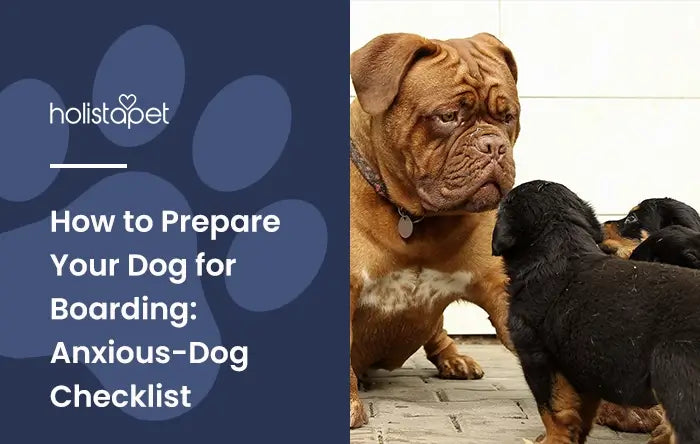
To prepare your dog for boarding, plan well ahead and confirm the vaccines that VCA's boarding guide lists as universally required: rabies, distemper, parvovirus, and Bordetella. Canine flu vaccines need two doses, so ask your vet about them early. Book a trial weekend before a longer visit, and pack your dog's usual food, since switching foods too quickly can upset their stomach. As you prepare, learn to recognize the signs your dog is stressed, and what helps so you can better support their comfort away from home.
Key points
- Many dogs new to boarding eat or drink less while there. VCA describes this as normal for the first few visits.
- Before booking, confirm that staff are willing and able to give your dog's medicine on schedule.
- Pack your dog's own bed or blanket, favorite toys, and usual food divided into daily portions.
- A dry, honking cough that begins in the days after boarding could be kennel cough. Call your vet.
- Labored breathing, a wet cough, a high fever, or nasal discharge may signal pneumonia. Call your vet now.
Is boarding stressful for dogs?
It can be, especially for an anxious dog during their first few visits. Many dogs new to boarding eat or drink less while there, which VCA's boarding guide calls normal for the first few visits. Tell the staff how your dog shows stress, so they can recognize your dog's usual reactions.

Which dogs are most likely to have boarding anxiety?
Consider what already frightens your dog, since boarding kennels bring together other dogs, strangers, and unfamiliar noises. In an owner survey of 13,715 Finnish pet dogs, 32% were reported as sensitive to noise, 17% as fearful of other dogs, and 15% as fearful of strangers. These findings reflect owner reports from a self-selected sample.
Separation anxiety is a different problem. The Merck Veterinary Manual describes it as a condition in which a dog panics when left alone. A dog may bark, pace, or have bathroom accidents indoors, with signs often worst in the first 15 to 30 minutes.
Do dogs get sad when they are boarded?
Your dog can't tell you how they felt, but the staff can describe how they behaved. Book a trial stay before a long trip, then ask how your dog ate, drank, and behaved. This gives you a better sense of how they cope before you're away longer.
If your dog panics in a crate at home
If your dog's kennel anxiety begins in their own crate at home, address that before booking. Start with the steps for a dog that panics in a crate, and ask each facility how dogs are housed during the day and at night.
Boarding or a pet sitter: which suits an anxious dog?
It depends on what your dog finds hardest: being left alone, other dogs, strangers, or noise. VCA's boarding guide lists three care options while you travel: care in your home, care in another home, or a boarding kennel.
With in-home care, your dog has familiar surroundings. Give the caregiver the same information sheet you would give a kennel.

Is it better to board a dog or get a pet sitter?
The best choice depends on your dog. Use the table below to start a conversation with your vet. The last column offers suggestions to discuss, rather than fixed rules.
| Your Dog | What to Consider | Option to Discuss with Your Vet First |
|---|---|---|
| Panics when left alone | Separation anxiety is panic when left alone, and Merck says signs are often worst in the first 15 to 30 minutes | Care where a person stays with your dog, in your home, or in another home |
| Fears other dogs | 17% of dogs in the Finnish owner survey were reported to fear other dogs, and a kennel houses many dogs in one place | In-home care, in a home without other dogs |
| Fears strangers | 15% of dogs in the same survey were reported to fear strangers; every option brings a new person unless the carer is someone your dog knows | A person your dog already knows |
| Sensitive to noise | 32% of dogs in the same survey were reported to be sensitive to noise; visit the facility and listen | In-home care, or a kennel you have toured and found quiet |
| Needs medicine on a schedule | The staff must be willing and able to give it on schedule | Any option, once the carer confirms they can give it |
| Has boarded calmly before | VCA calls eating or drinking less normal for the first few visits; ask the staff how your dog ate last time | The same facility |
If you suspect your dog has more than mild worry about being alone, read the signs of true separation anxiety before deciding.
If you choose boarding, visit the kennel first
Plan well in advance and visit the kennel before booking. VCA advises inspecting the indoor and outdoor areas and asking about daily routines. Kennels should be spacious, clean, and comfortable. Some boarding facilities are associated with veterinary hospitals and staffed by trained professionals. Take these questions with you:
- What does a normal day look like for the dogs here?
- Can I see the indoor and outdoor areas?
- Are your staff willing and able to give medicine on schedule?
- Is the facility associated with a veterinary hospital?
- Can my dog have a short trial visit first?
- Will you tell me how my dog ate and behaved?
When your dog is very stressed
Talk to your vet before booking. If your dog is very stressed, your vet may prescribe calming medicine or another treatment to help them adjust, according to VCA.
How to prepare your dog for boarding: a timeline
Begin planning as soon as you decide on the trip. VCA's boarding guide recommends planning well in advance and visiting the kennel beforehand. Both the two-dose canine flu vaccine and a trial weekend need room in your schedule.
What vaccines does my dog need for boarding?
Rabies, canine distemper, parvovirus, and Bordetella ("kennel cough") vaccines are universally required for boarding, according to VCA. Most kennels ask for written proof of vaccination from a licensed veterinarian. Your dog should also be up to date on parasite prevention.
The Bordetella vaccine is a lifestyle vaccine, recommended based on exposure risk, for dogs at least 12 weeks old. It does not prevent infection but can lessen the signs, according to Cornell's guide to kennel cough.
Ask your vet about canine influenza, too. These vaccines use inactivated virus and target the H3N8 or H3N2 strain, or both combined. Two doses are needed to build an effective immune response, as the Merck Veterinary Manual explains.
How early should you start planning a boarding stay?
Schedule a vet visit as soon as you book the trip, and ask how far in advance each vaccine should be given. This example allows about four weeks, counting back from a trip that starts on Wednesday, December 23, 2026.
| When | Example date | What to do |
|---|---|---|
| Four or more weeks before | By Wednesday, November 25 | Vet visit: check rabies, distemper, parvovirus, and Bordetella, get written proof, ask about canine flu (two doses) and parasite prevention. Tour kennels or line up a sitter. |
| Two to three weeks before | Saturday and Sunday, December 5 and 6 | A trial weekend at the kennel you chose, or a trial overnight with the sitter. |
| One week before | Wednesday, December 16 | Portion the usual food by day, pack the bag, write the staff info sheet, and check the microchip and ID tag (see the packing list below). |
| Drop-off day | Wednesday, December 23 | A walk or play session, then a short, calm handover. |
| Pickup and the days after | When you return | Check your dog's condition, ask about appetite and behavior, and watch for a cough. |
Book a trial stay first
Before a long trip, board your dog for a short period, such as a weekend or a few days, as VCA advises. Afterward, ask staff how your dog ate and behaved. Use what you learn to prepare for the longer visit.
Traveling for Thanksgiving?
If you leave on or near Thursday, November 26, call your vet and the facility this week. Book a trial stay if there is still time before the trip.
What to pack and what to tell the staff
Pack the essentials that keep your dog's routine familiar: their usual food, bed or blanket, favorite toys, and any medicine with written instructions. Include a one-page information sheet for the staff.
VCA's boarding guide says your dog's own bed or blanket and favorite toys can help them feel more comfortable. Pack their usual food, since a sudden switch can upset their stomach. Tufts' Petfoodology notes that significant stomach upset, including diarrhea, vomiting, excess gas, or constipation, suggests a diet change happened too quickly. It recommends mixing in new food gradually over at least one week.
Check that your dog's microchip registration has your current contact details and that their collar has current ID, as the AVMA advises.

What should I pack for my dog's boarding stay?
- The usual food, in portions labeled by day
- Your dog's bed or blanket
- One or two favorite toys
- Any medicine in its original labeled container, with written instructions
- A leash and a collar with current ID
-
The staff information sheet
The one-page staff info sheet
Predictability helps anxious dogs, so Cornell advises keeping meals, walks, play, and training at set times. The information sheet helps staff follow that familiar schedule. Fill in each row, keeping everything on one page.
| Section | What to write |
|---|---|
| Meals | Times, amounts, and the food you packed |
| Walks and play | Times and the games your dog enjoys |
| Medicine | Each medicine, the amount and the times, as your vet wrote them |
| Stress signs | What your dog does when it is stressed, such as barking or pacing |
| What helps | What helps your dog settle, such as its blanket, a walk, or a quiet corner |
| Contacts | Your phone number, an emergency contact, and your vet's name and phone number |
Drop-off and pickup
Give your dog a walk or play session before drop-off, and keep the goodbye short. At pickup, check their condition and ask how they ate and behaved.
Drop-off day
Start with exercise: VCA's guide to dog stress notes that exercise can help reduce stress. Then keep the handover short and calm, and give the information sheet to the person welcoming your dog.
Pickup and the first days home
When you pick up your dog, check their general condition and ask staff about their behavior and appetite, as VCA's boarding guide advises. At home, return to the usual meal and walk times. Cornell notes that predictability helps anxious dogs.
After boarding: what is normal and when to call the vet
Eating less during boarding can be normal, but a new cough after pickup warrants a call to your vet. Some breathing signs need immediate veterinary care. Many dogs new to boarding eat or drink less while there, which VCA calls normal for the first few visits.
What behavior is normal in the first days after boarding?
Excitement, lingering stress behaviors, and appetite changes are not unusual after boarding. Your dog may need a couple of days to return to their normal routine, according to the UC Davis School of Veterinary Medicine. During the first days home, you may notice:
- Lots of excitement about being home.
- Lingering stress behaviors, such as excessive whining, barking, digging, or chewing.
- Eating dinner too quickly or showing little appetite.
Keep the usual meal and walk times while your dog settles. If their behavior is not back to normal within a couple of days, UC Davis advises calling your vet.
Is it normal for my dog to cough after boarding?
A cough after boarding is a reason to call your vet, since it could be kennel cough or canine flu. Cornell describes kennel cough as a group of infections associated with places where dogs are in close contact.
These infections spread through droplets, dog-to-dog contact, and shared items. The typical sign is a dry, harsh, honking cough, sometimes with low energy and poor appetite. The incubation period, or time between exposure and signs appearing, is usually 2 to 10 days.
The Merck Veterinary Manual says to suspect kennel cough when this cough starts suddenly 5 to 10 days after contact with other dogs. The cough usually eases during the first 5 days but lasts 10 to 20 days.
Canine flu after a kennel stay
Canine influenza spreads through coughing, sneezing, and barking, as well as shared objects such as bowls and leashes. Kennels are a setting where exposure can occur, according to the Merck Veterinary Manual's page for dog owners. Signs usually start 2 to 4 days after exposure. Most infected dogs (80%) develop a mild infection with a cough that lasts 1 to 3 weeks.
Signs that need a vet visit now
Call your vet now if your dog has labored breathing, a wet cough, a high fever, or nasal discharge. Cornell says these signs can signal pneumonia, which requires more intensive treatment. Also call your vet if your coughing dog has low energy or is not eating.
A watch list for the days after pickup
Keep this table somewhere visible in the days after pickup. It summarizes the VCA, UC Davis, Cornell, and Merck guidance above.
| What you notice | When it can start | What to do |
|---|---|---|
| Ate or drank less during the stay | During the first few stays | Normal for the first few visits, according to VCA; go back to the usual meal times |
| Very excited, still whining, barking, digging or chewing, or eating too fast or too little | The first days home | It could take a couple of days to settle, says UC Davis; call your vet if behavior is not back to normal within a couple of days |
| A dry, harsh, honking cough | Usually 2 to 10 days after exposure (Cornell); Merck says suddenly, 5 to 10 days after contact | Call your vet; Merck says it usually eases during the first 5 days but lasts 10 to 20 days |
| A cough with lethargy or poor appetite | Canine flu signs usually start 2 to 4 days after exposure (Merck) | Call your vet |
| Labored breathing, a moist cough, a high fever, or nasal discharge | Any time | Call your vet now: these can mean pneumonia (Cornell) |
Calm support to pack for the stay
If your dog already has a calming chew as part of their daily routine at home, you can add it to the packing list. This helps keep their routine familiar. A chew is not medicine and does not replace your vet's advice.
HolistaPet makes CBD Calming Chews for Dogs, soft chews with broad-spectrum CBD in three strengths: 5 mg, 10 mg, or 20 mg of CBD per chew, with 30 chews in each pouch. If you pack a pouch of HolistaPet CBD Calming Chews, write the daily amount listed on the product label on the pouch.

Ask the facility whether staff can give the chews on schedule, just as VCA's boarding guide advises checking for medicine. Ask your vet first, especially if your dog takes medicine or your vet prescribes calming medicine for boarding.
The U.S. Food and Drug Administration says it has not approved cannabis for any use in animals and cannot ensure these products' safety or effectiveness. It advises owners to discuss treatment options with their veterinarian.
For a visit lasting several days, read how often a dog can have CBD before labeling the pouch.
Check out more dog care posts here
Sources
- VCA Animal Hospitals. Boarding Your Dog. 2025.
- UC Davis School of Veterinary Medicine (Animal Health Topics); Claire Youngerman. Choosing A Boarding Facility For Your Dog. 2019.
- Scientific Reports. Prevalence, comorbidity, and breed differences in canine anxiety in 13,700 Finnish pet dogs (Salonen M, Sulkama S, Mikkola S, et al.). 2020.
- Merck Veterinary Manual (Pet Owner Version). Behavior Problems in Dogs. 2026.
- Cornell University College of Veterinary Medicine, Riney Canine Health Center. The risks of kennel cough. Undated.
- Merck Veterinary Manual (Professional Version). Canine Influenza (Flu). 2025.
- Tufts University Cummings School of Veterinary Medicine (Petfoodology). How do I switch my pet's food?. 2019.
- American Veterinary Medical Association. Microchips reunite pets with families. Undated.
- Cornell University College of Veterinary Medicine, Riney Canine Health Center. Anxious behavior: How to help your dog cope with unsettling situations. 2025.
- VCA Animal Hospitals. Signs Your Dog is Stressed and How to Relieve It. 2025.
- Merck Veterinary Manual (Professional Version). Kennel Cough. 2024.
- Merck Veterinary Manual (Pet Owner Version). Canine Influenza (Flu). 2024.
- U.S. Food and Drug Administration. FDA Regulation of Cannabis and Cannabis-Derived Products, Including Cannabidiol (CBD). 2024.






Leave a comment
All comments are moderated before being published.
This site is protected by hCaptcha and the hCaptcha Privacy Policy and Terms of Service apply.