

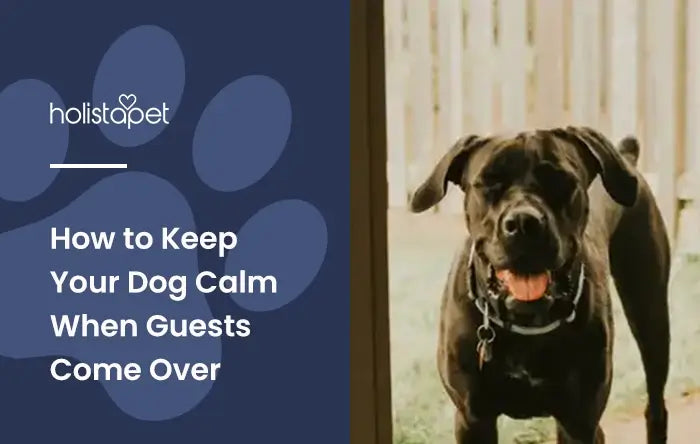
To keep your dog calm when guests come over, Cornell advises keeping regular meal and walk times and providing a quiet room to retreat to. Until door training is complete, move your dog away from the entryway before opening the door. Reward an excited dog for keeping four paws on the floor, and let a shy dog keep their distance. For more on what may unsettle your dog, read dog stress and anxiety, trigger by trigger.
Key points
- Set up a quiet retreat room before guests arrive, with a few blankets on the floor or an open bedroom door.
- Give an excited dog a treat as they approach a guest, before they jump, and continue rewarding them while all four paws are on the floor.
- End the greeting at the first sign of fear, such as refusing food, trembling, cowering, or trying to escape.
- Never leave young children or infants alone with any dog.
-
If your dog eats something toxic, call your vet or ASPCA Animal Poison Control at (888) 426-4435 right away; a consultation fee may apply.
Why dogs react to guests: excitement, territory or fear
First, identify your dog's reaction: excited greeting, door barking, or fear. Each calls for a different approach.
The excited greeter: jumping for attention
Social dogs jump when greeting people because it brings them closer to face level, according to VCA's guide to jumping up. They usually get attention for it, too. Even negative attention, such as scolding or pushing the dog away, can reward the jumping.
The door barker: guarding the house
Barking at the door reflects territorial behavior, which dogs are genetically inclined to show, according to VCA's guide to door barking. Fearful dogs can also learn that territorial barking keeps strangers away.
Why is my dog anxious around guests?
Some dogs are afraid of people. A fearful dog may cower, roll onto their back, look away, tuck their tail, lick their lips, tremble, pant, or hide behind you, according to VCA's guide to fear of people. A stiff posture may signal that your dog wants the interaction to end. They may then growl or snap.
In an owner survey of 13,715 Finnish pet dogs, 15% were reported to fear strangers. These figures came from owner reports in a self-selected sample.
Which type is your dog?
Match what you see to a starting approach. The sections below explain the full steps.
| Reaction | What you see | Why it happens | First fix |
|---|---|---|---|
| Excited greeter | Jumps up at guests, toward their faces | Jumping brings it closer to face level, and any attention, even scolding, can reward it | A treat before the jump, then more treats while all four paws stay on the floor |
| Door barker | Barks at the doorbell or a knock and rushes the door | Territorial behavior; fearful dogs also learn that barking keeps strangers away | Out of the area before the door opens; later, teach a mat routine |
| Fearful dog | Cowers, looks away, tucks its tail, licks its lips, trembles, pants or hides; may stiffen, then growl or snap | Fear of people; in the Finnish survey, owners reported fear of strangers in 15% of dogs | Let it choose not to meet guests; between visits, pair people at a distance with treats |
Before guests arrive: set up the house
Prepare four things before the doorbell rings: your dog's usual routine, a walk or play session, a retreat room, and a plan for the door.
Keep the routine to limit holiday stress for dogs
Keep your dog's normal meal and walk schedule on visit days, as Cornell's guide to holiday hazards advises. Before guests arrive, take your dog for a walk or have a play session. VCA's guide to dog stress notes that exercise can be a great stress reducer.

Schedule the walk for the morning, before the cooking begins and the doorbell rings.
Should your dog stay in another room during the visit?
Yes, for at least part of the visit. A quiet room to retreat to gives your dog a break and keeps them away from the entryway when the door opens. Cornell recommends providing a quiet retreat. ASPCA's Thanksgiving tips suggest leaving a few blankets on the floor or a bedroom door open. This gives your dog a quiet place to curl up and relax. Put a bowl of water in the room, too.
Use the room when opening the door as well. Until door training is complete, move your dog away from the entryway whenever you need to open the door, as VCA's guide to door barking advises.
Guests' bags, medicines and ID tags
Ask guests to keep bags containing medications closed and out of reach. Cornell's holiday guide recommends keeping guests' medications and other hazardous personal items away from your dog. With doors opening all day, register your dog's microchip, keep your contact details current, and make sure your dog wears a collar with up-to-date ID. The AVMA advises these precautions.
If you also have a cat, read about keeping a cat calm when the house is full.
A Thanksgiving visit-day timeline
Thanksgiving 2026 falls on Thursday, November 26, so this timeline begins two weeks earlier, on November 12.
| When | What to do |
|---|---|
| Two weeks before (from November 12) | Start the mat routine and the soft doorbell recording from the door-manners section below. |
| Thanksgiving morning | A walk or play session, and breakfast at the usual time. |
| One hour before guests arrive | Retreat room ready with blankets and water, a leash by the door, the trash emptied. |
| When guests arrive | Your dog out of the area, or on a leash, before you open the door. |
| The meal | No table scraps from guests; empty the trash again. |
| After guests leave | Quiet time for your dog in the retreat room. |
How to keep your dog calm when guests come over: the arrival
Move your dog away from the entryway or put them on a leash before opening the door. Reward calm greetings while all four paws are on the floor.
How do I stop my dog jumping on guests?
Offer a treat as your dog approaches the guest, before they try to jump, and keep rewarding them while all four paws are on the floor. This is the approach VCA's guide to jumping up recommends. If you want your dog to sit, wait until they have mastered "four on the floor," then ask for a sit and reward it. Hold the leash just taut enough to prevent an easy jump, without pulling or jerking.
Do not push your dog away or scold them: even negative attention can reward jumping. Avoid loud noises or a water spray, too. VCA warns that even these mild corrections can cause fear. If your dog nips when excited, read about a dog that nips visitors when excited.
How do I stop my dog barking at visitors?
Move your dog away from the trigger first if you notice signs of stress. VCA's guide to dog stress recommends this as the first step. Until door training is complete, VCA's door-barking guide advises moving your dog away from the entryway before opening the door. For a longer-term approach, teach the mat routine in the door-manners section below.
Guest rules to print for the front door
Print these rules for the front door or fridge. Each comes from the VCA, Cornell, and ASPCA advice in this article.
- Let the dog come to you.
- Do not hold or hug the dog to force a greeting.
- No table scraps: ask the host before offering any food or treats.
- Keep bags containing medications closed and out of reach.
- Leave the dog alone while they eat or sleep.
- Keep children from bothering the dog, and never leave young children alone with them.
If your dog is afraid of visitors
Let a fearful dog choose not to meet your guests, as VCA's guide to fear of people advises. Your dog can spend the whole visit in the quiet retreat room.
Should I make my dog say hi to guests?
No, not if your dog is fearful. Never hold your dog still to force a greeting. Stop the interaction at any sign of fear, such as refusing food, trembling, cowering, or trying to escape.
What do I do if my dog growls at visitors?
End the interaction calmly and give your dog space. A growl may follow a subtler signal, such as a stiff posture indicating that your dog wants the interaction to end. Do not punish or scold your dog. VCA warns that scolding a frightened dog will likely increase their fear and may make them afraid to be near you. Punishment may also contribute to aggressive responses warning signs that come before a bite.
How to build comfort between visits
Introduce people gradually, keeping enough distance for your dog to see the person and still accept treats. Pair the person's presence with something your dog loves. Move closer only while your dog is calm enough to eat.
When to get professional help
Consult a behavior professional if your dog shows intense fear or frustration at the door, as VCA's door-barking guide advises. Seek help, too, if you worry that their excitement could injure you or a visitor. Dogs that are very frightened of people should receive help from a qualified professional as soon as the fear is recognized. For some dogs, a vet may add medication to the behavior plan to reduce the intensity of fear.
Children, food and decorations: holiday-visit safety
Supervise every child around your dog, and keep holiday food, decorations, and trash out of reach. Have the poison hotline number and your nearest emergency hospital's contact details ready before the visit.
How do I keep my dog safe around visiting kids?
Never leave young children or infants alone with any dog. Children should not disturb a dog that is eating, sleeping, or caring for puppies, as VCA's guide to dogs and children advises. Most dog aggression toward children is fear-based. Teach adults to recognize subtle signs of fear or stress: yawning, lip licking, trembling, crouching, lowered ears, and a tucked tail. If your dog shows any sign of aggression, get professional help right away.
VCA, citing the CDC, reports that about 800,000 people seek medical care for dog bites each year. Half are children, and bites are most common among children aged 5 to 9.
What holiday foods are dangerous for dogs?
Keep turkey bones, raw or undercooked turkey, high-fat foods, onions and garlic, chocolate, desserts containing xylitol, raw yeast dough, grapes and raisins, and alcohol away from your dog. If you share a small bite of turkey, ASPCA's Thanksgiving tips say it should be boneless and fully cooked.
This table draws on Cornell's guide to holiday hazards and ASPCA's tips to explain each food hazard.
| Item | Why it is dangerous | Source |
|---|---|---|
| Turkey and other bones | Poultry bones can be a major choking hazard, and bones can also break teeth or cause blockages | ASPCA; Cornell |
| Raw or undercooked turkey | May carry salmonella | ASPCA |
| High-fat foods | Can cause vomiting and diarrhea, or even pancreatitis | Cornell |
| Onions and garlic | Can be toxic: they can irritate the gut and damage red blood cells, causing anemia | Cornell; ASPCA |
| Chocolate | Even small amounts can be severely toxic, and dark chocolate is especially dangerous; it can cause vomiting, diarrhea, panting, excessive thirst and urination, hyperactivity, an abnormal heart rhythm, tremors, seizures and even death | Cornell; ASPCA |
| Desserts with xylitol | Even small amounts can cause dangerously low blood sugar, seizures or liver damage, and xylitol can cause death | Cornell; ASPCA |
| Raw yeast dough | Can expand in the stomach and cause bloating, and its alcohol is absorbed by the body | ASPCA |
| Grapes and raisins | Can cause acute kidney failure, even in small amounts | Cornell |
| Alcohol | Can cause vomiting, diarrhea, tremors, breathing trouble, coma or death | Cornell |
Empty the trash throughout the day, or keep your dog away from it so they cannot get into anything harmful.
Decorations and plants to keep out of reach
Cornell's guide lists these decoration and plant hazards for dogs.
| Item | Why it is dangerous | Source |
|---|---|---|
| Tinsel and garland | Can block the intestines if swallowed | Cornell |
| Broken ornaments | Can injure the mouth, throat or gut, or cause choking | Cornell |
| Chewed electrical cords | Can cause electrical burns or electrocution | Cornell |
| Candles | A fire hazard if knocked over | Cornell |
| Poinsettia | Can irritate the mouth and stomach | Cornell |
| Holly | Can cause drooling, vomiting, diarrhea and poor appetite | Cornell |
| Mistletoe | Large amounts can cause vomiting, diarrhea, heart problems and low blood pressure | Cornell |
If your dog eats something dangerous
Call your vet or ASPCA Animal Poison Control at (888) 426-4435 right away; do not wait for signs. The line is available 24 hours a day, 365 days a year, and a consultation fee may apply. Before the holiday, find your nearest 24-hour emergency veterinary hospital, as Cornell advises.
Teaching door manners before the next visit
Teach your dog to lie on a mat instead of rushing the door. Then introduce the doorbell sound and practice greetings, in that order. VCA's guide to door barking calls lying on a mat an ideal alternative to rushing the door.
How do I train my dog to be calm when the doorbell rings?
- The mat. Reward your dog for lying on a mat. Vary the time before giving the treat, helping your dog learn to settle there for anywhere from 1 to 60 seconds.
- The doorbell. Play a recording of your doorbell very softly, increasing the volume only while your dog is calm, as the Merck Veterinary Manual describes. For a step-by-step version, use the doorbell drill from our Halloween plan.
-
Calm hellos. Before guests arrive, practice greetings on a leash in the yard or with a helper. Give treats while all four paws are on the floor, as VCA's guide to jumping up describes.
-
Real guests. Until door training is complete, continue moving your dog away from the entryway before opening the door.
Calm support for a busy holiday visit
A full house can mean a long, busy day for your dog. A calming treat can be part of the visit-day routine, alongside the retreat room and door plan. It does not replace training or your vet's advice.
HolistaPet makes hard CBD calming treats with broad-spectrum CBD, chamomile, and L-theanine. These hard chews are made with vegan ingredients, each treat is pre-measured, and every batch is third-party tested. Follow the label for how many to give.

Ask your vet before starting, especially if your dog takes any medication, and check the label for the amount of CBD in each chew before giving one. Try a treat on an ordinary, quiet day first so you know how your dog responds before the holiday.
The U.S. Food and Drug Administration says it has not approved cannabis for any use in animals. It cannot ensure these products' safety or effectiveness and advises owners to discuss treatment options with their veterinarian.
To compare formats before choosing, read CBD oils, treats and chews compared.
Sources
- Cornell University College of Veterinary Medicine, Riney Canine Health Center. Holiday hazards for dogs. 2024.
- VCA Animal Hospitals. Dog Behavior Problems: Greeting Behavior - Jumping Up. 2023.
- VCA Animal Hospitals. Dog Behavior Problems: Barking and Jumping at the Door. 2023.
- VCA Animal Hospitals. Fears and Phobias in Dogs: Animals and People. 2024.
- Scientific Reports. Prevalence, comorbidity, and breed differences in canine anxiety in 13,700 Finnish pet dogs (Salonen M, Sulkama S, Mikkola S, et al.). 2020.
- VCA Animal Hospitals. Signs Your Dog is Stressed and How to Relieve It. 2025.
- ASPCA. Thanksgiving Safety Tips. Undated.
- American Veterinary Medical Association. Microchips reunite pets with families. Undated.
- VCA Animal Hospitals. Dog Behavior Problems - Aggression - Children. 2019.
- ASPCA Animal Poison Control Center. ASPCA Poison Control. Undated.
- Merck Veterinary Manual (Pet Owner Version). Behavior Modification in Dogs. 2026.
- U.S. Food and Drug Administration. FDA Regulation of Cannabis and Cannabis-Derived Products, Including Cannabidiol (CBD). 2024.






Leave a comment
All comments are moderated before being published.
This site is protected by hCaptcha and the hCaptcha Privacy Policy and Terms of Service apply.