

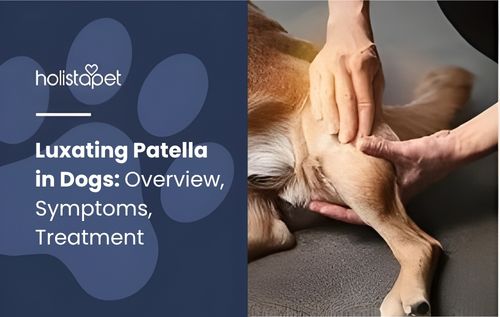
A sudden limp or a skipped step often signals a luxating patella in dogs. This condition causes the knee cap to slip out of its normal position, which disrupts movement and leads to discomfort.
Early recognition helps protect the knee joint and keeps dogs active and pain free.
What is Canine Luxating Patella?

Luxating patella in dogs refers to a condition where the patella slips out of its normal location in the knee joint, a diagnosis veterinarians confirm through physical exam and imaging (American College of Veterinary Surgeons – Patellar Luxation).
It can occur in one or both knees and appears as medial patellar luxation or lateral patellar luxation depending on the direction of the displacement.
How Do I Know If My Dog Has a Luxating Patella?
Watch how the dog moves. A luxating patella often shows clear signs during everyday activity.
- Intermittent lameness: The dog lifts the affected leg for a few steps, then returns to normal walking as the patella rests back in place.
- Kneecap slips: The kneecap slips out of its normal position, which creates a sudden skip or kick in the affected limb.
- Difficulty walking: The dog shows stiffness and struggles to move smoothly due to instability in the knee joint.
- Dog run changes: The dog run appears uneven, with sudden hops or pauses when the patella luxates.
- Affected limb weakness: The affected leg carries less weight, which leads to imbalance and reduced strength over time.
- Cracking or popping sounds: Movement in the stifle joint produces sounds as the patella shifts within the trochlear groove.
- Reduced activity: The dog avoids running or jumping because movement causes discomfort in the affected knee.
- Clinical signs in severe cases: Severe patellar luxation leads to постоян lameness and clear difficulty walking.
Can I Do a Luxating Patella Dog Massage?
Yes. Gentle massage can support comfort and improve circulation, but it does not fix patellar luxation. Use it as supportive care alongside veterinary guidance.
Step #1: Position the dog comfortably
Place the dog on a stable surface and keep the affected leg relaxed to avoid stress on the knee joint.
Step #2: Warm up the soft tissues
Use light strokes along the thigh bone and quadriceps muscle to increase blood flow.
Step #3: Massage the surrounding muscles
Apply gentle pressure around the quadriceps muscle and hamstrings to support stability in the stifle joint.
Step #4: Avoid direct pressure on the knee cap
Do not press on the patella or patellar tendon to prevent irritation or kneecap dislocation.
Step #5: Focus on the affected limb
Work slowly along the affected leg to reduce tension and improve comfort.
Step #6: Keep sessions short
Limit each session to a few minutes to avoid overworking the area.
Step #7: Monitor the dog’s response
Stop if the dog shows pain or discomfort and consult a veterinary surgeon if symptoms worsen.
Should I Take My Dog to the Vet for a Luxating Patella?

Yes. A suspected luxating patella in dogs needs a veterinary visit. Early care protects the knee joint and prevents worsening damage.
A veterinary surgeon performs a physical exam to check how the patella moves within the trochlear groove. A routine physical examination often confirms patellar luxation, while imaging may support a definitive diagnosis and reveal related orthopedic conditions.
- Persistent limping: Ongoing intermittent lameness or avoidance of the affected leg.
- Difficulty walking: Visible struggle with normal movement or use of the affected knee.
- Frequent kneecap dislocation: The patella luxates often instead of staying in place.
- One or both knees affected: Signs appear in one or both knees.
-
Pain or swelling: Irritation in the joint capsule and surrounding soft tissues.
Treatment depends on severity. - Conservative management: Healthy weight, joint supplements, anti inflammatory medications, and physical therapy for mild cases.
- Surgical intervention: Surgical correction for severe cases, including procedures like tibial tuberosity transposition.
- Recovery support: Canine rehabilitation helps restore strength and normal function.
Related Post: How To Help a Dog With Arthritis at Home
How Do You Treat a Luxating Patella in Dogs?
Treatment depends on severity. Mild cases improve with supportive care, while severe patellar luxation often needs surgical treatment.
|
Treatment Type |
Best For |
Key Benefit |
Notes |
|
Conservative management |
Mild cases |
Supports joint stability |
Works best with consistency |
|
Surgical correction |
Severe cases |
Restores normal position |
Performed by a veterinary surgeon |
|
Rehabilitation care |
Recovery phase |
Improves mobility |
Helps the dog recover safely |
Conservative Management
Mild patella luxation improves with targeted care that supports stability in the knee joint.
- Maintain a healthy weight to reduce pressure on the stifle joint.
- Use joint supplements that contain glucosamine and chondroitin because research shows they help protect cartilage and support joint health in dogs (Veterinary Partner – Joint Supplements for Dogs).
- Give anti inflammatory medications to control pain and swelling.
- Apply physical therapy to strengthen the quadriceps muscle and improve tracking.
The American College of Veterinary Surgeons notes that many dogs with early grade conditions stay stable with consistent conservative management.
Surgical Treatment
Severe cases or structural issues require surgical intervention to restore proper alignment and normal anatomy.
- Perform tibial tuberosity transposition to correct the patellar tendon alignment.
- Deepen the trochlear groove so the patella rests securely.
- Adjust soft tissues around the joint capsule to balance tension.
- Use surgical implants when needed to stabilize the knee cap.
Studies report high success rates for surgical correction of luxating patella, especially in small and large breed dogs when performed by specialists (Journal of Small Animal Practice – Patellar Luxation Surgery Outcomes).
Post Surgery Recovery
Recovery focuses on restoring strength and improving function in the affected limb.
- Start canine rehabilitation to rebuild strength and coordination.
- Limit activity to protect the affected leg during healing.
- Continue physical therapy to support normal function and mobility.
Most dogs return to comfortable movement when care remains consistent after surgical repair.
How Do I Prevent a Luxating Patella for My Dog?

Prevention focuses on reducing stress on the knee joint and supporting proper alignment as the dog grows and ages. Consistent care lowers the risk of patellar luxation and helps maintain normal function.
- Maintain a healthy weight: Reduces strain on the knee joint and supports stability.
- Support muscle strength: Regular exercise builds the quadriceps muscle to keep the patella in its normal position.
- Avoid excessive jumping: Limits stress on the affected knee and prevents kneecap dislocation.
- Use joint supplements early: Helps protect cartilage and support long term joint health.
- Schedule routine physical examination: Detects early changes before the dog’s condition worsens.
- Choose responsible breeding: Reduces risk in commonly affected breeds like yorkshire terriers and boston terriers.
- Prevent traumatic injury: Minimizes sudden damage that can affect the knee cap and soft tissues.
Are Certain Dog Breeds More Prone to Luxating Patellas?
Yes. Some breeds face a higher risk due to genetics and differences in normal anatomy that affect how the patella rests in the femoral groove.
- Small breed dogs: Higher risk of medial patellar luxation due to shallow trochlear groove and alignment issues.
- Yorkshire terriers: Commonly affected with early onset kneecap dislocation.
- Boston terriers: Prone to patella luxation linked to skeletal structure.
- Large breed dogs: More likely to develop lateral patellar luxation, often tied to abnormally shaped femurs.
- Large dogs: Increased risk when growth patterns affect the shin bone and thigh bone alignment.
- Genetic predisposition: Inherited traits influence how the patella tendon and joint structures develop.
Handle Your Dog’s Leg Issues Right Away
Early recognition and proper care keep dogs comfortable and mobile. With the right treatment and prevention, most dogs continue to live active and healthy lives despite patella luxation.
Frequently Asked Questions
Can a luxating patella get worse over time?
Yes. The condition can progress from mild to severe patellar luxation if left unmanaged, which increases joint damage and affects normal function.
Can a dog live normally with patellar luxation?
Yes. Many dogs stay active with proper care, especially in mild cases managed with weight control and physical therapy.
Is luxating patella painful for dogs?
Yes. Pain levels vary, but severe cases cause discomfort, inflammation, and difficulty walking in the affected knee.
At what age does patellar luxation appear in dogs?
It often appears in young dogs due to genetics, but traumatic injury can trigger it at any age.
How long does recovery take after surgery?
Most dogs recover within several weeks to a few months, depending on the surgical repair and follow up care.
Can exercise make patellar luxation worse?
Yes. High impact activity can strain the knee joint and increase the risk of the kneecap slipping out of place.
Do both knees always get affected?
No. Some dogs develop the condition in one knee, while others experience it in both knees over time.







Leave a comment
All comments are moderated before being published.
This site is protected by hCaptcha and the hCaptcha Privacy Policy and Terms of Service apply.