

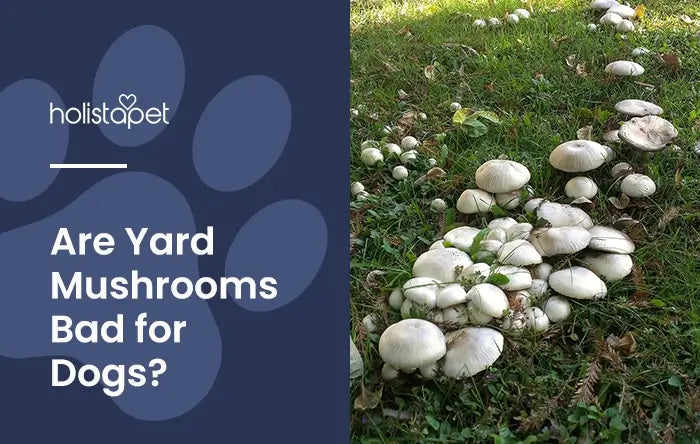
Yard mushrooms can be bad for dogs, and some are deadly. About 99% of mushrooms have little or no toxicity, but the toxic 1% can be life-threatening and difficult to distinguish from the others, warns the ASPCA. If your dog eats any yard mushroom, call your vet or ASPCA Animal Poison Control at (888) 426-4435 immediately. Never wait for signs: the deadliest mushrooms may cause no signs for 6 to 12 hours, according to Merck.
Key points
- As a rule, signs within 3 hours point to poisoning that resolves on its own, while signs after 6 hours point to life-threatening poisoning. Call now, even if your dog shows no signs.
- Amatoxin poisoning, the kind caused by death caps, can cause an apparent recovery up to 24 to 48 hours after eating, before the liver and kidney phase begins.
- Place any leftover mushroom in paper or waxed paper, not plastic, and refrigerate it for your vet.
- Do not make your dog vomit unless your vet or the poison control center tells you to.
- Fall is mushroom season. In warm, damp weather, check the yard and remove mushrooms promptly.
Are yard mushrooms bad for dogs?
Some are deadly, and most toxic mushrooms are hard to tell apart from nontoxic ones. That is why the ASPCA's autumn safety tips advise keeping pets away from areas where mushrooms grow.
Only about 1% of mushrooms are highly toxic, the ASPCA notes, but they can cause life-threatening problems in pets. A single cap from a death cap (Amanita phalloides) or A. ocreata can contain a lethal dose for an animal or a person, according to Merck's chapter on slow-acting mushroom toxins.

This article focuses on wild mushrooms that grow outdoors. For supplements and everyday nutrition, see our guide to dog vitamins and supplements.
Why are dogs at special risk?
Dogs are especially likely to be poisoned by mushrooms because they eat without being selective and tend to roam, according to Merck's overview of mushrooms toxic to animals. Smell may also play a role. Dogs show particular interest in Amanita phalloides and Inocybe species, possibly because of their fishy smell, notes the North American Mycological Association (NAMA).
Are lawn and garden mushrooms safer than wild ones?
No. A mushroom in a tidy lawn or garden bed is still a wild mushroom, and the ASPCA's warning about distinguishing toxic mushrooms from nontoxic ones applies there, too. One poisonous species, Chlorophyllum molybdites, often forms full or partial “fairy rings” in lawns, grassy areas, and open woods, according to University of Florida extension scientists.
Can dogs get sick from sniffing mushrooms?
The poisonings discussed in this article all follow eating a mushroom. A sniff can lead to a quick bite. If you did not see whether your dog ate any, act as if it did. NC State's veterinary college advises seeking emergency care immediately whenever you suspect your dog ate a mushroom.
What to do right now if your dog ate a yard mushroom
Call your vet, an emergency clinic, or ASPCA Animal Poison Control at (888) 426-4435 now, even if your dog seems fine. The ASPCA's poison line is open 24 hours a day, 365 days a year, and a consultation fee may apply.
Checklist: a mushroom in your dog's mouth
- Call now. Phone your vet, an emergency clinic, or ASPCA Animal Poison Control at (888) 426-4435.
- Do not wait for signs. The deadliest mushrooms may cause no signs for 6 to 12 hours, followed later by an apparent recovery, according to Merck's chapter on slow-acting mushroom toxins.
- Bag a sample. Place any mushroom you can collect in a paper bag or waxed paper, not plastic. Refrigerate it until it can be examined, as NAMA advises.
- Photograph the mushrooms where they grew. Take pictures of the top, the underside, and the base of the stem.
- Note the time and amount. Write down when your dog ate the mushrooms and roughly how many.
- Do not make your dog vomit unless your vet or the poison center tells you to.
-
Take the sample and photos to the clinic.
Should I make my dog throw up?
Do not do this on your own. Let your vet or the poison center decide. Making a dog vomit is not recommended in some cases, says the Merck Veterinary Manual's page on treating poisoning. Two examples: more than a few hours have passed since eating, or the dog is having seizures.
Why early care matters
There is no proven antidote for mushroom poisoning, according to Merck's overview of mushrooms toxic to animals. That makes acting quickly the main thing you can control. NC State's veterinary college warns that waiting can cost precious time.
When mushroom poisoning signs show up, and why a quiet dog is not a safe dog
Signs can begin within minutes or take 6 to 12 hours to appear, depending on the mushroom. As a rule, mushrooms that cause signs within 3 hours of eating cause poisoning that resolves on its own and is not life-threatening, according to Merck's overview of mushrooms toxic to animals. Those that cause signs more than 6 hours after eating cause life-threatening poisoning.
Do not use this rule as a reason to wait at home. You rarely know which mushroom your dog ate, and a quiet dog may be in the silent first phase of a deadly poisoning.
How long does it take for a dog to show signs of mushroom poisoning?
Signs can appear anywhere from about 5 minutes to 12 hours, depending on the mushroom group. The table organizes the main groups by when signs begin. Its first four rows come from Merck's chapter on fast-acting mushroom toxins.
| When signs start | Mushroom group (examples) | Main signs | How dangerous | Source |
|---|---|---|---|---|
| Often 5 to 30 minutes, generally within 2 hours | Muscarine mushrooms (Clitocybe and Inocybe species) | Drooling, watery eyes, urination, diarrhea, trouble breathing and vomiting, with a slow heart rate, small pupils, low blood pressure, shock and belly pain | Can kill dogs | Merck; NAMA |
| 15 minutes to 3 hours | Stomach irritants (including Chlorophyllum molybdites and Russula emetica) | Vomiting, bloody diarrhea, belly pain and muscle cramps, sometimes liver injury | Recovery usually within 6 to 24 hours; death is rare | Merck |
| 30 minutes to 1 hour, rarely up to 3 hours | Psilocybin mushrooms | Aggression, wobbliness, vocalizing, abnormal eye movements, seizures and a raised body temperature | Dogs recover within about 6 hours of the first signs | Merck |
| 30 to 120 minutes | Isoxazole mushrooms (Amanita muscaria and A. pantherina) | Disorientation, weakness, seizures, paddling, chewing movements, and wobbliness or head tilt; signs last about 24 hours | NAMA says A. muscaria kills dogs only in rare instances | Merck; NAMA |
| No signs for 6 to 12 hours, then a possible false recovery | Amatoxin mushrooms (Amanita phalloides, A. ocreata, A. bisporigera, Lepiota species, Galerina marginata and Conocybe filaris) | A gut phase, a false recovery, then a liver and kidney phase | Life-threatening; one death cap or A. ocreata cap can hold a lethal dose |
Merck |
| 6 to 12 hours | Gyromitra esculenta | Vomiting, watery diarrhea, belly discomfort, convulsions and coma | Life-threatening; anemia, liver and kidney damage and death can follow later | Merck |
The 3-hour rule has exceptions. NAMA notes that Inocybe species and muscarine-containing Clitocybe species can kill dogs, even though signs appear early.
No signs yet does not mean your dog is safe. A dog that ate a deadly mushroom can look normal for hours. Call as soon as you know or suspect your dog ate one.
Why a death cap poisoning can look like a recovery
Amatoxin poisoning, the kind caused by the death cap, can progress through four phases, though not every case shows all four, Merck explains:
- Silent phase: No signs for 6 to 12 hours after eating.
- Gastrointestinal phase: Up to 24 hours after eating.
- False recovery: Up to 24 to 48 hours after eating, when the dog appears to have recovered.
- Liver and kidney phase: 36 to 72 hours after eating, leading to recovery or death over the next 7 to 14 days.
Real cases follow this pattern. In one week in May 2025, NC State's veterinary hospital saw two confirmed cases of dogs dying from death cap poisoning. Both were emergency referrals from Guilford and Wake counties. NC State describes vomiting, diarrhea, and stomach upset within 6 to 12 hours of eating, followed by a deceptive “honeymoon phase” when signs briefly improve. Dogs often then progress to liver failure.
How quickly poisoning progresses also varies. Puppies or dogs that eat a large amount of amatoxins can die within 24 hours, according to Merck.
Which yard mushrooms are poisonous to dogs?
Use this list to describe a mushroom to your vet, not to decide whether it is safe. Most toxic mushrooms are difficult to distinguish from nontoxic ones, the ASPCA warns. That's why it's important to call your vet if your dog eats any mushroom.

What do poisonous mushrooms look like?
There is no single appearance to watch for, because most toxic mushrooms resemble harmless ones. The next table lists each dangerous group, its toxin, when signs appear, and the danger it poses.
| Mushroom | Toxin group | When signs start | Danger to dogs | Source |
|---|---|---|---|---|
| Amanita phalloides (death cap) | Amatoxins | No signs for 6 to 12 hours | Deadly; one cap can hold a lethal dose | NAMA; Merck (slow toxins) |
| Amanita ocreata and A. bisporigera | Amatoxins | No signs for 6 to 12 hours | Life-threatening; one A. ocreata cap can hold a lethal dose |
Merck (slow toxins) |
| Galerina marginata | Amatoxins | No signs for 6 to 12 hours | Life-threatening | Merck (slow toxins); NAMA |
| Lepiota species | Amatoxins | No signs for 6 to 12 hours | Life-threatening | Merck (slow toxins); NAMA |
| Conocybe filaris | Amatoxins | No signs for 6 to 12 hours | Life-threatening | Merck (slow toxins); NAMA |
| Inocybe species | Muscarine | Often 5 to 30 minutes | Can kill dogs | Merck (fast toxins); NAMA |
| Clitocybe species | Muscarine | Often 5 to 30 minutes | Muscarine-containing species can kill dogs | Merck (fast toxins); NAMA |
| Amanita muscaria and A. pantherina | Isoxazoles | 30 to 120 minutes | A. muscaria kills dogs only in rare instances | Merck (fast toxins); NAMA |
| Gyromitra esculenta | Gyromitrin | 6 to 12 hours | Life-threatening; death can follow later | Merck (slow toxins) |
| Chlorophyllum molybdites (green-spore poison parasol) | Stomach irritant | 15 minutes to 3 hours | Death is rare; recovery usually within 6 to 24 hours | Merck (fast toxins); University of Florida |
NAMA also notes that some Scleroderma species can kill dogs and pigs, though not people.
The lawn mushroom that forms fairy rings
Chlorophyllum molybdites, the green-spore poison parasol, grows in lawns. University of Florida extension scientists say it is widespread in Florida and the Southeast. It often forms full or partial “fairy rings” in lawns, grassy areas, and open woods. It has a large cap, a ring on the stem, and a greenish color under the gills.
What the vet will do for mushroom poisoning
There is no proven antidote, so treatment mainly involves removing the toxin from the gut and providing intensive supportive care, according to Merck's overview of mushrooms toxic to animals. Your vet will choose the treatment for your dog.
Death cap poisoning is nearly 100% fatal without treatment, according to NC State's veterinary college. The liver and kidney phase can begin 36 to 72 hours after eating, according to Merck's chapter on slow-acting mushroom toxins.
Expect follow-up visits. A poisoned dog can appear well during the false recovery phase, so attend every recheck your vet schedules, even if your dog seems better.

Bring the refrigerated sample for examination, as NAMA advises, along with your photos of where the mushrooms grew.
How to keep your dog away from yard mushrooms
Remove yard mushrooms promptly, and supervise your dog outside in warm, damp weather, as NC State's veterinary college advises. Never let your dog eat a wild mushroom.
Prepare for mushroom season. Fall is mushroom season, notes the ASPCA, which advises keeping pets away from areas where mushrooms grow. Watch your dog closely on walks, too.
How do I get rid of mushrooms in my yard?
Pick mushrooms as soon as they appear, and check again after rain. Follow this short routine to build the habit:
- After rain, bring your dog indoors, then walk the yard with gloves and a paper bag.
- Check under shrubs, along fences, and in shady parts of the lawn.
- Bag and discard every mushroom, including its base.
- Wash your hands.
- Check again the next morning.
Teach "leave it" and use a leash
A reliable “leave it” command helps you stop your dog before a mushroom reaches its mouth. In parks and woods, keep your dog on a leash during mushroom season.
Wild mushrooms vs. mushrooms in food and supplements
This article focuses on the danger of unidentified wild mushrooms. Store-bought mushrooms and mushroom supplements are a separate question.
For grocery mushrooms, read about store-bought mushrooms and dogs. If you cook for your dog, see our post on cooked oyster mushrooms for your dog.
A mushroom supplement identifies its species on the label. HolistaPet makes Immune Support + Functional Mushroom Soft Chews, which combine Lion's Mane, Maitake, Reishi, Shiitake, and Turkey Tail with vitamin C, astragalus, colostrum, DHA, EPA, and astaxanthin. Each bag contains 30 or 60 soft chews. If you add them to your dog's daily wellness routine, let your vet know.
Sources
- ASPCA. Autumn Safety Tips. Undated.
- Merck Veterinary Manual (Birgit Puschner, DVM, PhD, DABVT). Overview of Mushrooms Toxic to Animals. 2025.
- Merck Veterinary Manual (Birgit Puschner, DVM, PhD, DABVT). Toxin Latent Period >6 Hours After Ingestion of Mushrooms. 2024.
- Merck Veterinary Manual (Birgit Puschner, DVM, PhD, DABVT). Toxin Latent Period 3 Hours or Less After Ingestion of Mushrooms. 2024.
- University of Florida IFAS Extension, EDIS (Lisbeth Espinoza and Matthew E. Smith). Green-Spore Poison Parasol Mushroom, Chlorophyllum molybdites (PP324). 2016.
- North American Mycological Association (NAMA), toxicology. Mushroom Poisonings in Dogs and Cats. 2023.
- NC State University College of Veterinary Medicine (news). Pet Owner Alert: Toxic Mushrooms Claim Dogs' Lives. What You Should Know. 2025.
- ASPCA Animal Poison Control Center. ASPCA Poison Control. Undated.
- Merck Veterinary Manual, pet owner version (Steve M. Ensley, DVM, PhD). General Treatment of Poisoning. 2024.






Leave a comment
All comments are moderated before being published.
This site is protected by hCaptcha and the hCaptcha Privacy Policy and Terms of Service apply.