


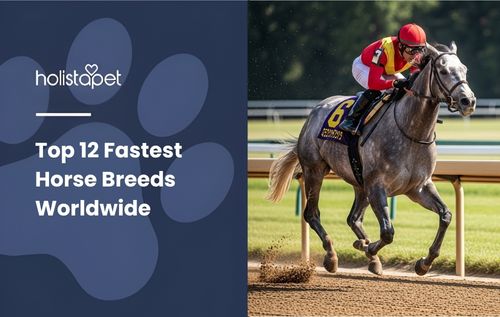
Speed shapes success in horse racing, and certain horse breeds lead the pack. The American Quarter Horse dominates a quarter mile with explosive acceleration, while Arabian horses thrive in endurance racing across long distances.
This guide highlights the fastest horse breeds in the world and explains what drives their impressive speed.
What are the Fastest Horse Breeds in the World?

Top-performing equine breeds achieve elite racing performance through powerful muscles, efficient stride mechanics, and generations of selective breeding. Thoroughbred horses lead in top speed, while the American Quarter Horse dominates short distances and Arabian horses excel across long distances.
|
Rank |
Breed |
Top Strength |
Best Use |
Notable Trait |
|
12 |
Appaloosa Horses |
Agility |
Barrel racing |
Versatile horses |
|
11 |
American Paint Horse |
Acceleration |
Ranch work |
Balanced frame |
|
10 |
Standardbred Horses |
Consistency |
Harness racing |
Steady gait |
|
9 |
Mustang |
Endurance |
Trail riding |
Wild horses resilience |
|
8 |
Andalusian |
Precision |
Dressage |
Ancient horses lineage |
|
7 |
Friesian |
Power |
Carriage work |
Muscular build |
|
6 |
Akhal Teke Horses |
Efficiency |
Endurance |
Metallic coat |
|
5 |
Morgan Horse |
Versatility |
Farm horses |
Strong build |
|
4 |
Arabian Horses |
Stamina |
Endurance racing |
Long distances |
|
3 |
Thoroughbred Horses |
Speed |
Flat racing |
Long legs |
|
2 |
American Quarter Horse |
Sprinting |
Short races |
Quarter mile dominance |
|
1 |
Winning Brew |
Record speed |
Race track |
Fastest recorded speed |
12. Appaloosa Horses
Key Traits:
- Muscular body: Supports quick bursts of speed
- Strong hind legs: Improve acceleration
- Versatile horses: Adapt to multiple equestrian disciplines
Appaloosa horses rank among recognizable breeds known for agility and adaptability. The Nez Perce tribe originally bred them for utility, which shaped their athletic abilities. They perform well in barrel racing and pleasure riding, where quick turns and control matter more than raw speed.
11. American Paint Horse
Key Traits:
- Muscular build: Enhances short bursts
- Fast twitch muscle fibers: Support quick acceleration
- Balanced frame: Improves control on a race track
The American Paint Horse shares lineage with the American Quarter Horse, which explains its strength in short distance races. Riders often choose this breed for equestrian sports that demand speed and precision. Its horse's performance depends on explosive starts and agility.
10. Standardbred Horses
Key Traits:
- Efficient gait: Ideal for harness racing
- Strong muscle mass: Supports pulling power
- Consistent stride: Maintains steady pace
Standardbred horses dominate harness racing, where they pull carriages at fast but controlled speeds. The United States Trotting Association highlights their ability to maintain consistent pacing over distance. Their strength lies in endurance and rhythm rather than peak speed.
9. Mustang
Key Traits:
- Natural endurance: Supports long distance trail riding
- Lean muscular body: Aids efficiency
- Strong instincts: Improve stamina
Mustangs represent wild horses shaped by natural selection. They lack the selective breeding seen in modern racing breeds but excel in survival and endurance. These local horses cover long distances across rugged terrain with steady speed.
8. Andalusian
Key Traits:
- Compact build: Supports agility
- Powerful hind legs: Enhance movement
- Responsive nature: Improves control
The Pure Spanish Horse, known as the Andalusian, traces back to ancient horses of the Iberian Peninsula. This breed shines in equestrian disciplines that require precision. It delivers impressive speed combined with control rather than raw racing performance.
7. Friesian
Key Traits:
- Powerful build: Supports strength
- Long legs: Improve stride reach
- Draft influence: Adds pulling capability
Friesians combine elegance with strength. They often pull carriages and perform in exhibitions. Their muscular build creates a powerful stride and strong forward momentum.
6. Akhal Teke Horses
Key Traits:
- Lean muscle mass: Supports endurance and speed
- Long legs: Increase stride efficiency
- Distinctive metallic coat: Reflects unique genetics
Akhal Teke horses rank among the oldest horse breeds. Originating from Central Asia near the Arabian Peninsula, they developed for harsh conditions. Experts often note their ability to cover long distances while maintaining steady speed.
5. Morgan Horse
Key Traits:
- Compact build: Enhances power
- Strong muscle development: Supports versatility
- Balanced frame: Improves control
Morgan horses stand out among versatile horses used in farm horses work and riding. They perform across different breeds and disciplines. Their combination of strength and stamina allows solid speed and reliability.
4. Arabian Horses
Key Traits:
- Exceptional endurance: Excels in long distance endurance races
- Efficient breathing: Supports stamina
- Lightweight frame: Improves efficiency
Arabian horses lead endurance racing worldwide. Originating from the Arabian Peninsula, they developed to survive harsh climates. The Arabian Horse Association emphasizes their ability to cover long distances with minimal fatigue, making them ideal endurance horses.
3. Thoroughbred Horses
Key Traits:
- Long legs: Maximize stride length
- Muscular body: Supports high speeds
- Large heart capacity: Improves oxygen flow
Thoroughbred horses dominate flat racing across major race track events. Modern thoroughbreds result from centuries of selective breeding focused on speed. A thoroughbred named Winning Brew achieved the fastest recorded speed at about 43.97 mph at Penn National Race Course, according to Guinness World Records.
2. American Quarter Horse
Key Traits:
- Explosive muscle mass: Drives rapid acceleration
- Fast twitch muscle fibers: Enable quick bursts
- Powerful hind legs: Dominate short distances
The American Quarter Horse stands as the fastest horse over a quarter mile. This breed excels in short distance races such as barrel racing. Its horse's speed peaks quickly, making it ideal for sprint events.
1. Thoroughbred Named Winning Brew
Key Traits:
- Elite conditioning: Maximizes output
- Advanced muscle development: Enhances acceleration
- Optimized stride: Increases top speed
Winning Brew holds the record as the fastest horse ever measured. This Thoroughbred reached its top speed during a Penn National Race, setting a global benchmark. Guinness World Records confirms this achievement, placing it at the top among horse breeds in the world.
What are the Qualities of Fast Horses?
Fast horses rely on physical strength, efficient movement, and proper conditioning to reach high speeds and maintain performance.
Muscular Build and Power
A strong muscular body allows horses to run with greater force and speed, especially during acceleration.
- High muscle mass supports explosive movement.
- Fast twitch muscle fibers allow quick bursts of speed.
- Strong hind legs generate forward propulsion.
Research from the University of California Davis explains that fast twitch fibers play a key role in sprint performance by producing rapid and powerful contractions.
Stride Length and Efficiency
An efficient horse's stride helps cover more ground with less effort, which increases overall speed.
- Long legs improve stride length and reach.
- Flexible joints allow smoother and more efficient movement.
- Balanced structure helps maintain rhythm at high speeds.
Equine biomechanics experts state that stride efficiency directly impacts a horse’s performance on the racetrack.
Cardiovascular Strength
Strong heart and lung function support sustained speed and delay fatigue.
- Large heart capacity improves oxygen delivery to muscles.
- Efficient lungs support endurance during intense activity.
- Stable circulation helps maintain peak performance.
The American Association of Equine Practitioners notes that elite racehorses often show enhanced cardiovascular capacity, which supports high intensity work.
Lightweight Structure
A lean build allows faster movement while maintaining strength and control.
- Lean muscle reduces unnecessary weight.
- Strong bones support speed without increasing bulk.
- Efficient body composition improves agility.
This structure allows horses to reach impressive speed without compromising stability.
Training and Conditioning
Proper preparation ensures horses perform at their highest level across different equestrian sports.
- Consistent training builds strength and stamina.
- Balanced nutrition supports muscle development.
- Regular exercise improves overall horse's health.
Experts in equestrian disciplines emphasize that conditioning plays a major role in helping horses excel and maintain peak performance.
How Do I Take Care of a Racing Horse?

Caring for a racing horse requires proper nutrition, structured training, routine health care, and recovery support to maintain speed, strength, and overall health.
Balanced Nutrition
A well-planned diet fuels muscle development and supports peak performance on and off the race track.
- High quality forage supports digestion and overall health.
- Protein intake helps build and repair muscle mass.
- Electrolytes replace minerals lost during intense exercise.
Equine nutritionists stress that racehorses need precise feeding plans to sustain energy and maintain a strong muscular body.
Structured Training
Consistent training improves horse's ability to perform at high speeds while reducing injury risk.
- Interval workouts build speed and endurance.
- Strength exercises improve power in the hind legs.
- Rest days allow recovery and prevent overtraining.
Trainers design programs based on the horse's performance goals in flat racing or other equestrian sports.
Routine Veterinary Care
Regular checkups keep the horse in optimal condition and detect issues early.
- Physical exams monitor overall horse's health.
- Vaccinations protect against disease.
- Dental care ensures proper feeding and comfort.
The American Association of Equine Practitioners recommends routine evaluations to maintain peak performance in competitive horses.
Recovery and Joint Support
Proper recovery helps maintain muscle development and prevents strain after intense workouts.
- Cooling down reduces muscle stiffness after exercise.
- Massage improves circulation and relaxation.
- Joint supplements support mobility and comfort.
Some horse owners study veterinarian-approved CBD products to support relaxation and joint comfort during recovery, but usage should always be guided by a licensed veterinarian
Always consult a veterinarian before adding supplements to a horse’s routine.
Safe Housing and Environment
A clean and secure environment supports both physical health and mental well-being.
- Proper ventilation reduces respiratory issues.
- Clean bedding prevents infections.
- Spacious areas allow movement and reduce stress.
A well-managed stable helps horses stay calm and ready for training or competition.
Horses Bring More Than Stamina

Fast horses combine power, precision, and endurance shaped by breeding, training, and care. Each breed shows unique strengths, but proper management and health support determine how well a horse reaches and maintains its full speed potential.
Frequently Asked Questions
What is the fastest recorded speed of a horse?
The fastest recorded speed reached about 43.97 mph by a Thoroughbred named Winning Brew at Penn National Race Course, according to Guinness World Records.
Which horse breed handles both speed and endurance well?
Arabian horses handle both speed and stamina effectively, especially in long distance endurance races across challenging terrain.
Do all fast horses perform well in every type of race?
No. Some breeds excel in short distances like the American Quarter Horse, while others perform better in long distances like Arabian horses.
What role does breeding play in a horse’s speed?
Selective breeding improves muscle development, stride efficiency, and overall athletic abilities, which directly increase speed.
Can wild horses compete with trained racing horses?
No. Wild horses show strong endurance and adaptability, but trained racing horses outperform them in controlled races due to conditioning and specialized breeding.
How does age affect a horse’s speed?
Most horses reach peak performance between ages four and six, when strength, coordination, and conditioning align.
What type of surface affects a horse’s speed the most?
Track surfaces like dirt, turf, and synthetic materials affect traction, stride, and overall performance during races.
How do riders influence a horse’s speed?
Skilled riders improve timing, balance, and control, which helps the horse maintain rhythm and maximize speed during a race.








Leave a comment
All comments are moderated before being published.
This site is protected by hCaptcha and the hCaptcha Privacy Policy and Terms of Service apply.